What Is Nippon Sangoku? Historical References and What Makes It So Enjoyable
Nippon Sangoku is a manga and anime war epic that reimagines Japan as a fallen near-future nation, drawing on the classic Chinese tale of the Three Kingdoms. From the plot and characters to real-world place names and hidden references to The Tale of the Heike and the Emishi people, here is what to look for to enjoy the series on a deeper level.
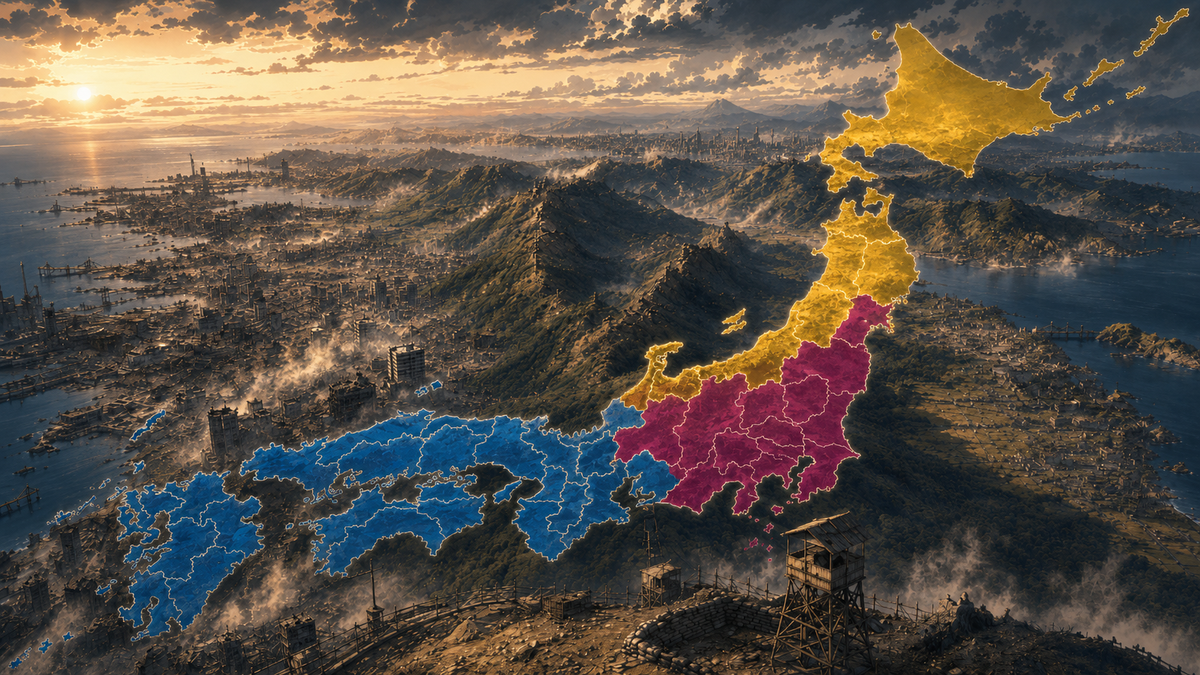
Nippon Sangoku is a manga and anime war epic set in a near-future Japan that has slid into ruin. Its lead is a young man who sets out to change that broken world with words and strategy rather than swords.
The foundation underneath the story is the Chinese classic Romance of the Three Kingdoms, a tale that has long been popular in Japan as well. The series layers elements of the Japan we live in today onto that base, along with traces of ancient Japanese history. You can enjoy it without any background knowledge, but a little familiarity with the Three Kingdoms or Japanese history adds another dimension to the reading experience.
Here is a closer look at what makes Nippon Sangoku so engaging, and the slices of Japanese culture you can catch glimpses of along the way.
What Is Nippon Sangoku?
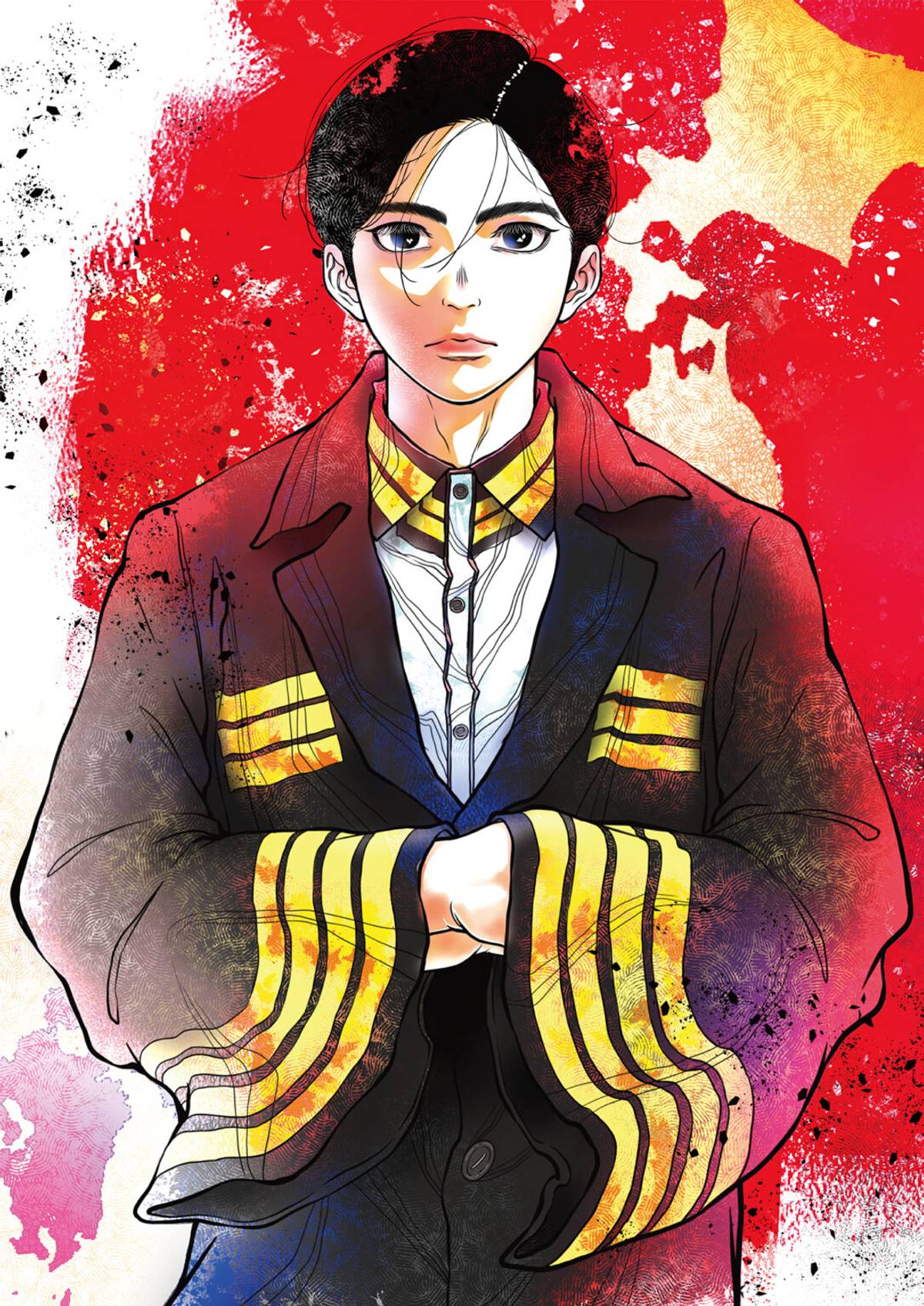
©松木いっか/小学館/日本三國製作委員会
The title is read as Nippon Sangoku, and the manga is written by Ikka Matsuki. It has been running since 2021 on Shōgakukan's manga app MangaONE and on the website Ura Sunday. By the end of March 2026, total series circulation had passed one million copies. The story was adapted for the stage in 2025, and a TV anime produced by Studio Kafka began airing in April 2026.
Word of mouth got another boost when Hideo Kojima, the director behind the Metal Gear and Death Stranding series, recommended the manga on social media.
A Quick Look at the Story
Nuclear war, waves of refugees, a sweeping pandemic, a massive earthquake, and a people’s revolution all struck Japan during the Reiwa era. The chain reaction wiped out the state itself, cut the population to less than a tenth of what it had been, and rolled the level of civilization back to the early Meiji period, the late nineteenth century.
Out of the ruins, Japan splits into three nations, Yamato, Buō, and Seii, which then begin to fight for supremacy. The protagonist is Aoteru Misumi. He starts out as nothing more than a regional bureaucrat, but a painful parting pushes him to chase a far bigger goal, bringing the divided country back together as one. His only weapons are knowledge and a sharp tongue. The story follows how this man, later known as the ‘genius strategist’, makes his way through an age of upheaval.
Meet the Main Cast
Here is a quick rundown of the key figures who drive the story forward.
Aoteru Misumi
The protagonist. A strategist who rises from a regional government post, with no real fighting ability of his own. He carves his path with logic and persuasive speech.
In a past interview, the author shared that Aoteru is modeled on Deng Ai, a general who served the kingdom of Wei during the Three Kingdoms period.
Saki Higashimachi
Aoteru's wife. Losing her is the moment that pushes him into the chaos of the wider world. She is the character who sets the entire story in motion.
Strong-willed and refreshingly direct, she leaves a deep mark on Aoteru's outlook.
Yoshitsune Asama
Nicknamed Tsune-chan-san, he is Aoteru's colleague from the same intake of officials. A confident young man, gifted in combat. Where Aoteru relies on his head, Yoshitsune cuts through obstacles with his sword skill.
The author has revealed in a past interview that Yoshitsune is based on Zhong Hui, a general who stands as Deng Ai's counterpart. Zhong Hui is the very man who brought down and ruined Deng Ai, the model for Aoteru.
Denki Taira
The central antagonist. A member of the Taira clan that holds the real power in Yamato. Cold-blooded, but a political operator of the highest order, ruling as a dictator in all but name.
Mitsuhide Ryūmon
A frontier general of Yamato. Skilled in both letters and arms, and a man of upstanding character. He is the lord Aoteru hopes one day to serve.
Yasuaki Kaku
Yamato's strategist, and a tactical mind on par with Aoteru.
Fuji III
The emperor of Yamato, though emperor only in name. Real power lies with Denki Taira, who pulls his strings from the shadows. He is a timid, faint-hearted figurehead.
A map of the territories in Nippon Sangoku
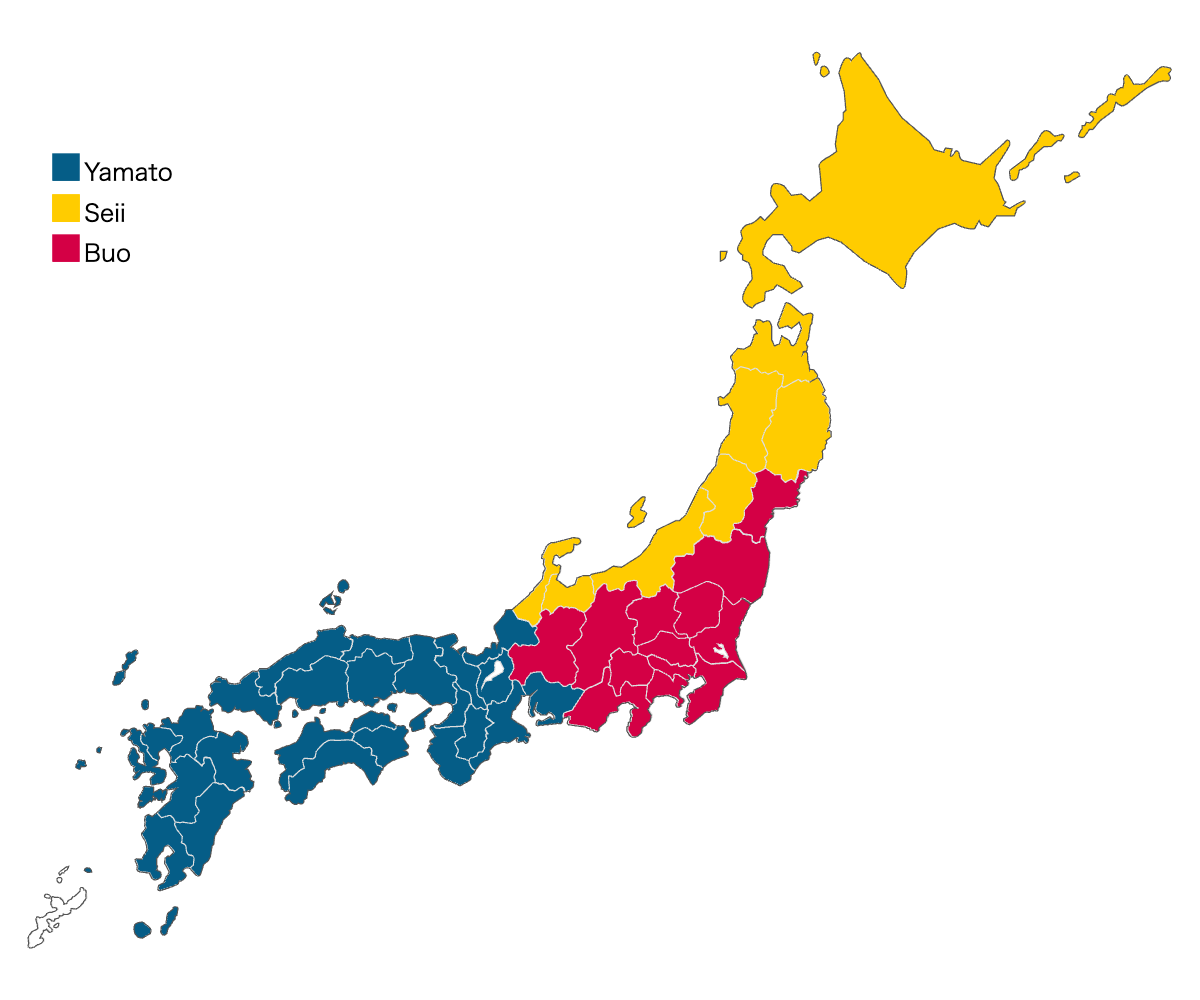
The map above shows the distribution of territories at the start of the story. As the story progresses, the lands under occupation will shift and change.
Real Japanese Place Names Appear in The Story
The three nations of Yamato, Buō, and Seii do not exist on a present-day map of Japan. Yet the lands that make up each of those nations carry the real names of modern Japanese places, exactly as they are today. Yamato is centered on Osaka, and the battlefields of Seii stretch across Niigata and Kanazawa. The settings of the story are real places you can still walk through.
You can travel to many of the spots that show up in the series, so if you are a fan, a seichi junrei (a pilgrimage to locations from your favorite anime or manga) is well worth considering.
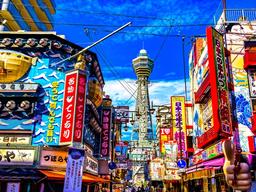
Modern Japanese Slang Frequently Get Used
Casual youth slang such as gachi (for real) and wakarimi ga fukai (I really feel that) shows up again and again throughout the series.
Even in stiff, serious scenes, the characters drop this kind of slang so nonchalantly, which gives the scenes an oddly surreal vibe that is hard to describe.
Readers from outside Japan with some grasp of Japanese will likely catch themselves smiling at the contrast. It is one of the small touches that makes the world feel like a direct extension of present-day Japan rather than a far-off fantasy.
The Story Behind the Inspiration: What Is Sangokushi?
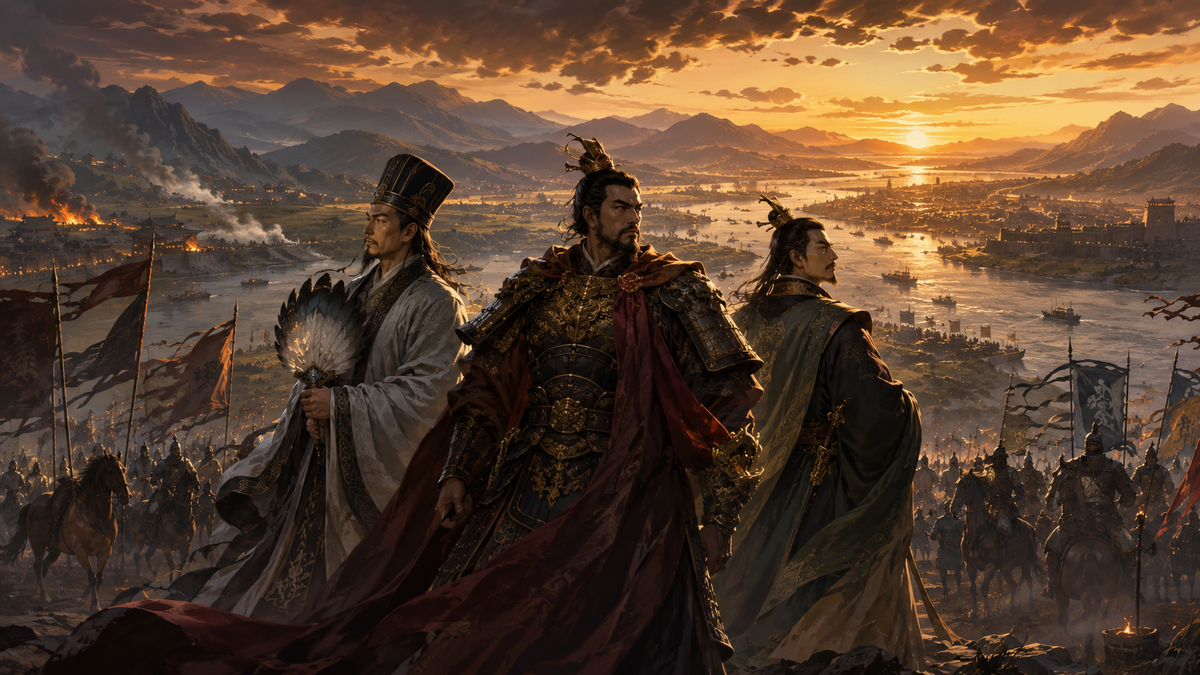
Sangokushi refers to the history of ancient China about 1,800 years ago. After the great Han empire collapsed, three states named Wei, Wu, and Shu fought for control of the realm. The history reaches us through two main texts. One is the historical chronicle Records of the Three Kingdoms, and the other is the heavily dramatized novel Romance of the Three Kingdoms. Nippon Sangoku is built on the foundation of the novel.
A Long-Standing Favorite in Japanese Manga and Games
In Japan, the Three Kingdoms has long been a beloved source of inspiration.
Mitsuteru Yokoyama's manga, Koei's Romance of the Three Kingdoms and Dynasty Warriors game series, and titles like Ya Boy Kongming!, in which Zhuge Liang reawakens in present-day Shibuya, have all taken inspiration from the material time and again. The figure of the strategist Zhuge Liang (Kongming) in particular has become synonymous in Japan with genius.
Even More Enjoyable with Knowledge of Japanese History
The names of the characters are inspired by famous military commanders and historical figures who actually existed in Japanese history. Of course, they are not meant to be the historical figures themselves, so they do not share the exact same names. However, their bloodlines, roles, and positions are clearly designed to evoke those real-life counterparts, making it especially satisfying once you recognize the historical references.
What follows is one writer's reading rather than confirmed authorial intent, but the parallels with real Japanese history are striking.
A Structure Similar to The Tale of the Heike and the Genpei War
The main antagonist is named Denki Taira, and his clan is the Taira. Aoteru's fellow new recruit, meanwhile, is called Yoshitsune Asama.
A Taira clan basking in its prime, and a Yoshitsune rising to bring it down. The setup calls to mind the Genpei War of roughly 800 years ago, when the Minamoto and Taira clans clashed for control of Japan, and the classic epic that recorded its fall, The Tale of the Heike (Heike Monogatari).
Even the name of the emperor, Fuji, faintly evokes the historical Fujiwara clan, the noble house that quietly shaped Heian-era politics. The shape of the political setup here is almost certainly no accident.
The Yamato Court, the Emishi, and Aterui
The character i (夷) in the name of the northern nation Seii (聖夷) is the same character once used in ancient Japan to refer to the Emishi people, indigenous groups who lived in the Tōhoku region and resisted the rule of the Yamato court.
Seii is home to a character named Aterui Kura. The historical Aterui was a real Emishi leader who stood against the Yamato court and is still remembered as a hero of his people. Set against that backdrop, the rivalry between the western power Yamato and the northern Seii starts to feel like a quiet echo of Japan's ancient history.
The Mōri Clan, Famous for Their Political Maneuvering
In the ongoing manga, the Mōri clan also enters the picture, portrayed as a family rich in strategic talent. The historical Motonari Mōri, who governed the Chūgoku region during the Sengoku period, was known for expanding his power through clever scheming and political maneuvering. Saddling these characters with that same surname gives readers an instant hint about the kind of role they will play, and that wink at history is part of the fun.
Final Thoughts
What makes Nippon Sangoku stand out is the way it puts Aoteru Misumi’s eloquent rhetoric, the ambitions of each faction, and the tangled web of strategy at the heart of the story.
It also pulls history and culture into its frame, weaving Japan's own layered past into a tale anchored in a Chinese classic. The way present-day Japanese slang slips naturally into the dialogue is something unique to the story’s setting, a Japan that has collapsed in the wake of the Reiwa era. This gives the work a novel atmosphere not seen often.
It’s also impressive how faithfully the anime captures the manga’s distinctive art style. The original manga is still ongoing, and the story adapted in the anime is only going to become more exciting from here, so there’s every reason to look forward to what comes next.
FAQ
Published Last Updated
Related Articles
Explore more articles on similar topics and deepen your knowledge of Japan.

Related Titles
Everything we have on this title: real life locations, stories, and where to get it.