Nine-Tails / Kurama: The Fox Spirit Legend Behind Naruto, from Tamamo no Mae to the Killing Stone
The nine-tailed fox that Kurama is based on in Naruto. We explore the sacred beast of ancient China, the Tamamo no Mae legend, and the Killing Stone in Nasu that split in half in 2022.

The kyuubi no kitsune (nine-tailed fox) is a fox yokai with nine tails. These days, readers all over the world probably think of Kurama, the beast sealed inside the protagonist Naruto in Naruto, when they hear the name.
The Nine-Tails in the series is a fictional creature, one of the tailed beasts. Even so, the yōkai and the legends behind a fox with nine tails have long been passed down across East Asia, from the books of ancient China to the popular fiction of the Edo period.
A sacred beast once treated as a good omen becomes, at some point, a seductress who brings down kingdoms. And why did the Sesshō-seki (Killing Stone), the stone left behind at the end of the legend, make world news in 2022?
Here we trace the path of the nine-tailed fox, thought to be the source behind Kurama in Naruto.
Who Is Kurama, the Nine-Tails in Naruto?
Naruto is a ninja manga by Masashi Kishimoto. It ran in Weekly Shōnen Jump from 1999 to 2014, and together with the anime it found readers all over the world.
The story reveals that sealed inside the protagonist, Naruto Uzumaki, is the huge beast that once attacked his village. That beast is the Nine-Tails.
The Nine-Tails is one of nine beasts known as the tailed beasts. Each has a different number of tails, and the strongest of them, the one with nine, is the Nine-Tails. Its real name is Kurama.
Sealed into Naruto just after his birth, it is hated and feared for a long stretch of the story, and then, in the later arcs, the two come to call each other partners. It is the kind of turn fans call “emoi” (emotional), one that hits them right in the heart.
The character database on the series' official site describes Kurama only as a fictional beast and never mentions the fox legends. Then again, the legend is so deeply rooted in Japan that saying it out loud hardly needs doing at this point.
From here on, we turn to the actual legends of the nine-tailed fox.
From Sacred Beast to Seductress: The Lineage of the Nine-Tailed Fox
The oldest record of the nine-tailed fox appears in the Shanhaijing (Classic of Mountains and Seas), an ancient Chinese geographical treatise. In a land called Qingqiu there lives a beast shaped like a fox, with nine tails and a cry like a human baby. It eats people, yet anyone who eats its flesh is protected from evil influences. That is how this strange creature is described.
It Began as a Sacred Beast
Surprisingly, it was originally an auspicious animal. The Baihu Tong, a text from the Han dynasty, lists it alongside the phoenix and the qilin as a sacred beast that appears only when a ruler's virtue reaches every corner of the realm. The Engishiki, a Heian-period Japanese code of law, also records the nine-tailed fox as a sacred beast.
Daji, the Peerless Beauty Who Led People Astray
The turn in its reputation came with Daji of the Shang dynasty. The legendary beauty who beguiled the tyrant King Zhou, the dynasty's last ruler, was in truth a nine-tailed fox. Once Ming-dynasty novels such as Fengshen Yanyi (Investiture of the Gods) spread that storyline, the nine-tailed fox became synonymous with the seductress who topples a kingdom.
Fox spirits of the same lineage are found across East Asia, starting with the kumiho of the Korean Peninsula.
And in Japan there is a fox spirit who inherited her image.
The Legend of Tamamo no Mae: The Fox Who Enchanted Emperor Toba
The setting is the imperial capital, Kyoto, at the end of the Heian period. A young woman named Tamamo no Mae served at the side of Retired Emperor Toba. She was extraordinarily beautiful and so learned that she could answer any question put to her, and she quickly won his favor.
Her True Form Is Exposed
Before long the retired emperor fell ill with no explanation. The onmyōji who performed the divination, Abe no Yasunari, saw what she really was: a fox spirit in human form.
Exposed, Tamamo no Mae fled the palace and escaped to Nasuno in Shimotsuke Province, in what is now the area around the town of Nasu in Tochigi Prefecture.
Struck Down Yet Still Dangerous
The court ordered warriors of the eastern provinces to hunt her down. The fox drove off her pursuers once, but against a force that had sharpened its aim by practicing on horseback against dogs, she was finally brought down by an arrow. That training is also said to be one origin of inuōmono, a mounted archery event.
The story does not end there. The dead fox is said to have turned into a huge poisonous stone, and the people, birds and animals that came near it died one after another. People called that stone the Sesshō-seki, the Killing Stone.
She Only Became a Nine-Tailed Fox in the Edo Period
In fact, the earliest versions of the Tamamo no Mae story contain no nine-tailed fox at all. Older texts give her two tails. The nine-tailed version dates from the Edo period. Popular books of the early nineteenth century such as Ehon Sangoku Yōfuden linked Daji in China and Tamamo no Mae as transformations of the same fox, and that version stuck.
The legend also reached the stage. In the Noh play Sesshō-seki, a woman appears before a monk named Gennō and tells him where the stone came from, and the fox spirit behind her accepts the rite that subdues her and vanishes. Tamamo no Mae has been performed again and again in kabuki and in jōruri puppet theater as well.
What She Shares with Kurama
The nine-tailed fox of legend has a different character from Kurama in the series, but the two share the quality of holding enormous power.
Speaking as a Japanese person, this is how it feels to me. The nine-tailed fox is sacred, uncanny and awe-inspiring all at once.
The Sesshō-seki Actually Exists
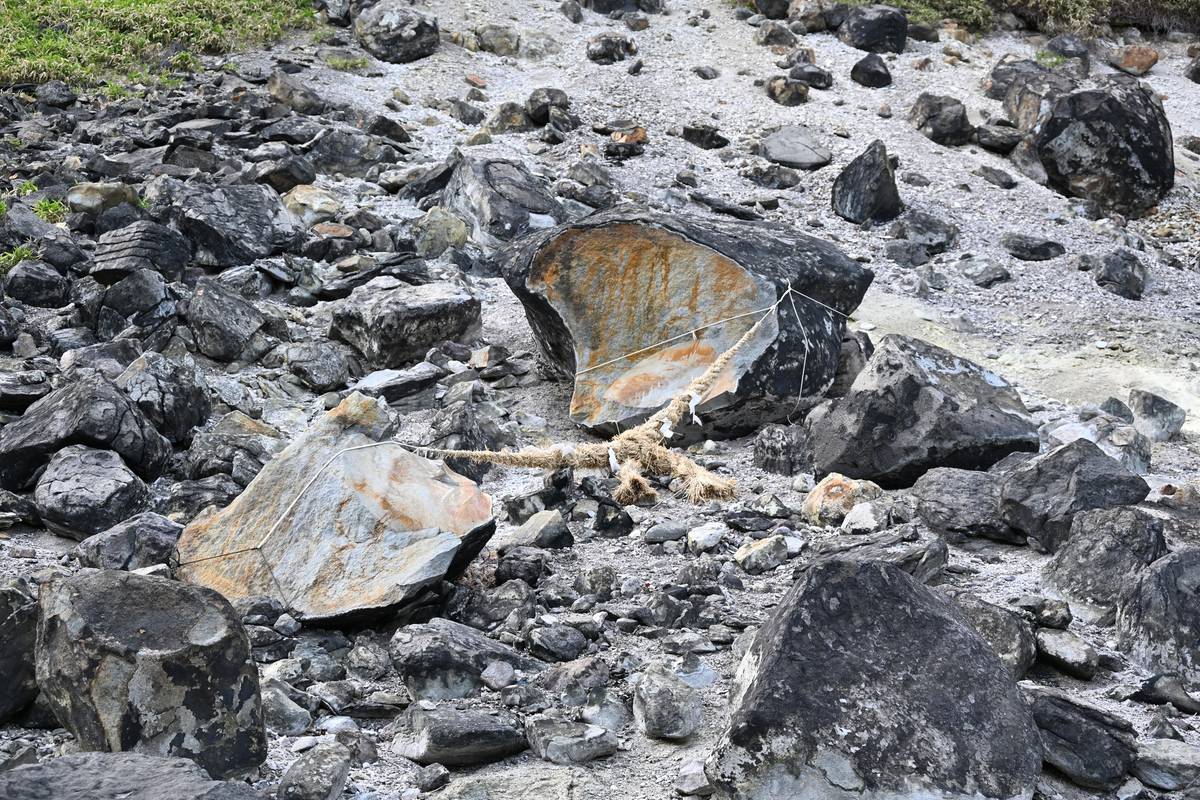
The Sesshō-seki mentioned above can still be visited today. It sits in Nasu Yumoto Onsen (Nasu Yuzen Shrine) in the town of Nasu, Tochigi Prefecture. In a sulfur-scented hollow called Sai no Kawara, a large boulder hung with a sacred straw rope lies on the ground.
The poison of the legend is not an invention. Volcanic gases including hydrogen sulfide really do vent here, and when the concentration rises, access is restricted.
That is what the life-taking stone really is. I find it genuinely moving that an old legend turns out to have a modern chemical explanation.

A Famous Japanese Poet
Matsuo Basho came here in 1689. In Oku no Hosomichi (The Narrow Road to the Deep North) he wrote that “the poison of the stone has not yet perished,” and went on to describe bees and butterflies lying dead in heaps thick enough to hide the color of the sand.
In 2014 this area was designated one of the country's Places of Scenic Beauty under the title Scenic Sites of Oku no Hosomichi.
Did a Monk Shatter the Stone with Spiritual Power?
There is also a legend about a monk who broke the stone apart. In 1385 the priest Gennō is said to have shattered the Sesshō-seki with his spiritual power, and the fragments that scattered left stones of the same name in places across the country. One explanation for why a heavy stone-splitting hammer is called a gennō traces the word to this priest's name.
In 2022 It Really Did Split
The split Sesshō-seki
In March 2022 the Sesshō-seki really did split. The cause is thought to be a natural one, such as freezing. All the same, photographs of the boulder broken in two traveled through news outlets and social media around the world, setting off speculation that the nine-tailed fox had woken up.
The broken stone was not carried away, and it is still enshrined where it lies. You can see it up close from the walking path, but the poison has not gone anywhere.
In December 2022, eight wild boar were found dead in a hollow where the gas had pooled. Even if you are there as a tourist, never go near it.
Is the Nine-Tailed Fox the Same as an Inari Fox?
An Inari fox and the nine-tailed fox / AI Generated
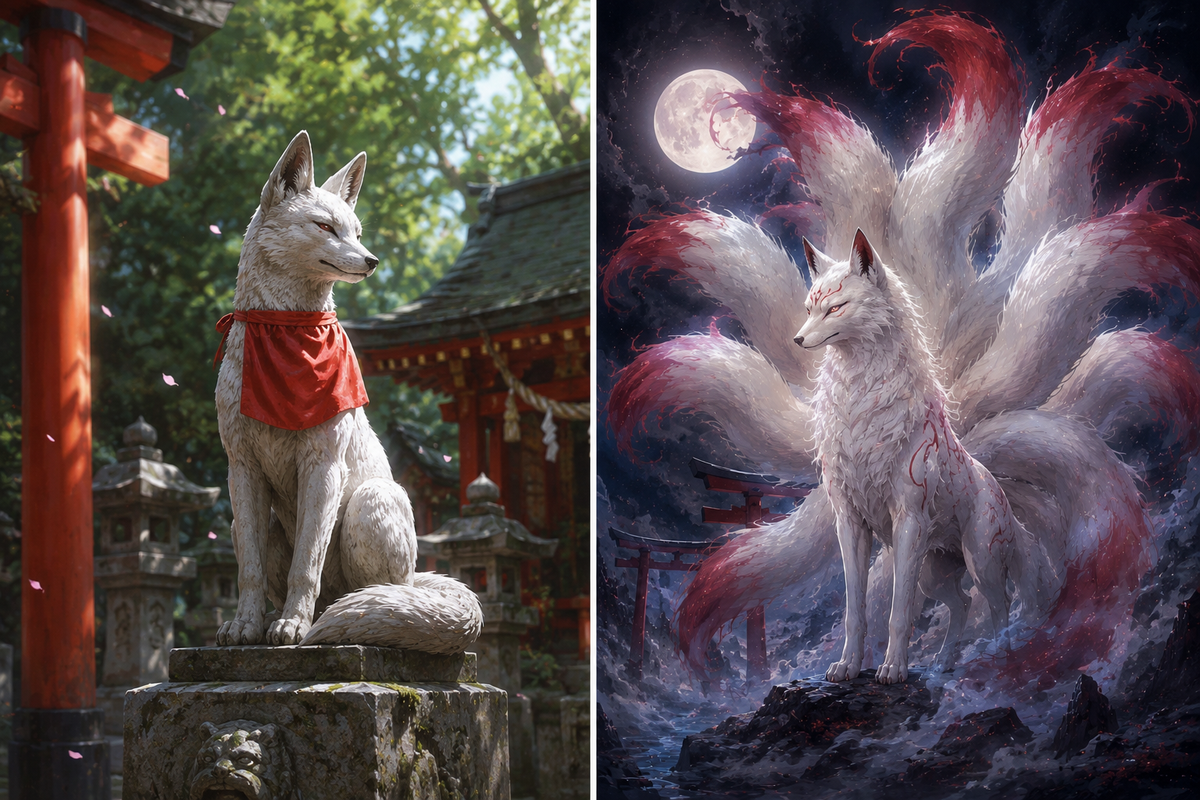
As a general rule, the inari foxes at ordinary shrines and the nine-tailed fox are two different things. The fox statues you see at shrines are sacred animals serving as messengers of the Inari deity, auspicious figures tied to good harvests and prosperous business. They're not the same as fox yokai like the nine-tailed fox.
Both are foxes, but Inari foxes have been revered while fox spirits have been feared. Articles written for readers overseas often lump the two together, but when someone in Japan puts their hands together before a fox statue, they are not praying to the nine-tailed fox.
There are exceptions, though. Nasu Yuzen Shrine, the site of the Sesshō-seki mentioned earlier, and Tamamo Inari Shrine both enshrine the nine-tailed fox. I am not claiming this is necessarily why these two shrines do so, but in many parts of Japan there are traditions of enshrining evil spirits and malevolent beings in order to pacify them.
Following the Nine-Tailed Fox Further
The same shape you know from the anime, a fox with nine tails, carries a long history behind it, from sacred beast to seductress to a single stone. If you make the trip out to the Nasu Highlands, where the legend is set, you can see the split Killing Stone with your own eyes, in much the same spirit as fans visiting the real-world locations behind their favorite series.
If you want to know more about yōkai and strange phenomena themselves, there is also an article on the creatures that appear in Dandadan.

FAQ
Published Last Updated
Related Articles
Explore more articles on similar topics and deepen your knowledge of Japan.






Related Titles
Everything we have on this title: real life locations, stories, and where to get it.