Nasu Yuzen Shrine
那須温泉神社
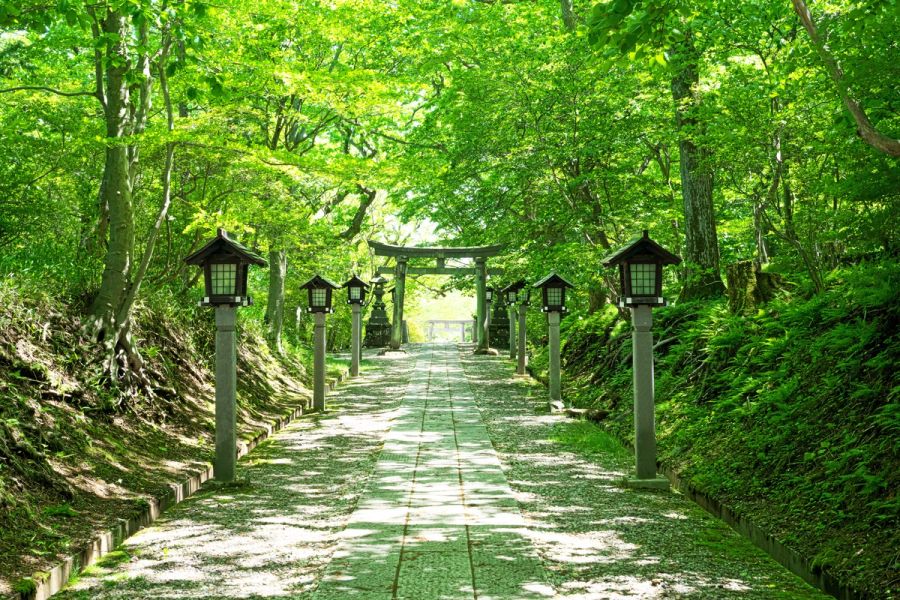
About Nasu Yuzen Shrine
Nasu Yuzen Shrine stands right beside the Sesshō-seki, the Killing Stone of the nine-tailed fox legend. It sits on high ground in Nasu Yumoto Onsen, a hot spring town in Nasu, Tochigi Prefecture, where the smell of sulfur drifts through the air.
The shrine's name is written with the characters for hot spring, normally read onsen, but here they are read yuzen. The shrine is said to have been founded in the early seventh century, around 630. The grounds are open and there is no charge to visit.
From JR Kuroiso Station, a local bus bound for Nasu Yumoto Onsen takes about 35 minutes, and the shrine is a one-minute walk from the Nasu Yumoto Onsen stop.
The Hot Spring a White Deer Led the Way To
The shrine begins with a story about a hunter chasing a deer. Around 630, a hunter named Kano Saburō Yukihiro followed a white deer that had taken his arrow and fled, and he pushed deep into the mountains. There, the story goes, he found the deer soaking in a hot spring welling up from the ground, healing its wound.
The spring found this way is said to be Shika no Yu, the Deer's Hot Spring, still in use today as a public bathhouse. The shrine traces its origin to the deity enshrined to watch over that water.
The waters of Nasu appear in written records early as well. A government record from 738 notes that an official of the Ono clan set out from the capital for Nasu with twelve attendants to take the waters. Word of this hot spring had already reached the capital at Nara.
Three deities are enshrined here: Ōnamuchi no Mikoto and Sukunahikona no Mikoto, gods of hot springs and medicine, together with Hachiman (Hondawake no Mikoto), the god of the bow and arrow.
A god of hot springs and a god of archery stand side by side in a single hall. What carried this shrine's name across the country was an episode involving the bow.
The Shrine Behind Nasu no Yoichi's Famous Shot
The Battle of Yashima, 1185. Two warrior houses, the Minamoto and the Taira, faced each other on the Seto Inland Sea. The Taira raised a fan on a small boat and dared the Minamoto to shoot it down. The shot fell to a young warrior from Nasu, Nasu no Yoichi.
Yoichi rode his horse into the sea and took aim at the fan on the boat as it rocked on the waves. The Tale of the Heike records the prayer he spoke at that moment.
“Hail Hachiman, Great Bodhisattva, and you gods of my home province, Nikkō Gongen, the god of Utsunomiya, and Nasu no Yuzen Daimyōjin, grant that I may strike the very center of that fan.”
Nasu no Yuzen Daimyōjin, the great deity of the Nasu hot spring. The characters for hot spring water there are read yuzen, and they point to this very shrine. The arrow struck the fan, and the fan fluttered down into the sea.
The Tale of the Heike is a war chronicle compiled in the early thirteenth century, a Japanese classic that tells of the late twelfth-century war between the Minamoto and the Taira. The scene of the fan target appears in school textbooks, and many people in Japan read it in class.
After the battle, Yoichi is said to have given thanks by donating a shrine hall and dedicating an arrow and a fan. Ever since, this has been a shrine for contests of every kind, and visitors still come to pray for victory. At the counter where charms are given out, you will find one called Isshi Hitchū Mamori, whose name is the wish itself: that a single arrow hits its mark (800 yen, as of August 2026).
Kyūbi Inari Shrine on the Grounds
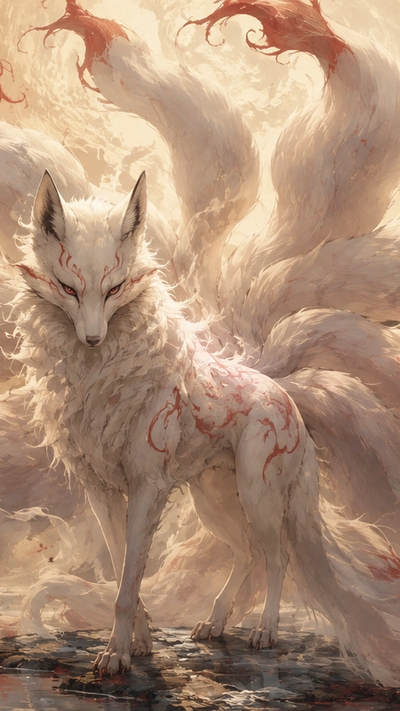
Beside the main hall stands a small shrine called Kyūbi Inari Shrine, the Nine-Tailed Fox Inari Shrine.
The Sesshō-seki just behind the shrine is the setting of the Tamamo no Mae legend, in which a fox spirit exposed in the capital fled to Nasuno, was struck down, and turned into a poisonous stone. Inari is a god of commerce and crops, worshipped with foxes as divine messengers. This sub-shrine enshrines the nine-tailed fox as an Inari deity. It is said to bring success in business and money matters, and in the performing arts.
Separate from the one for the main shrine, it has its own goshuin, the seal stamp given to visitors as a record of their visit, and there are charms shaped like the nine-tailed fox. A fox long told of as a terrifying yōkai, a monster of Japanese folklore, is enshrined on the same ground as a deity who brings good fortune. That swing between the two is what makes Japanese belief interesting.
You Can Walk to the Killing Stone
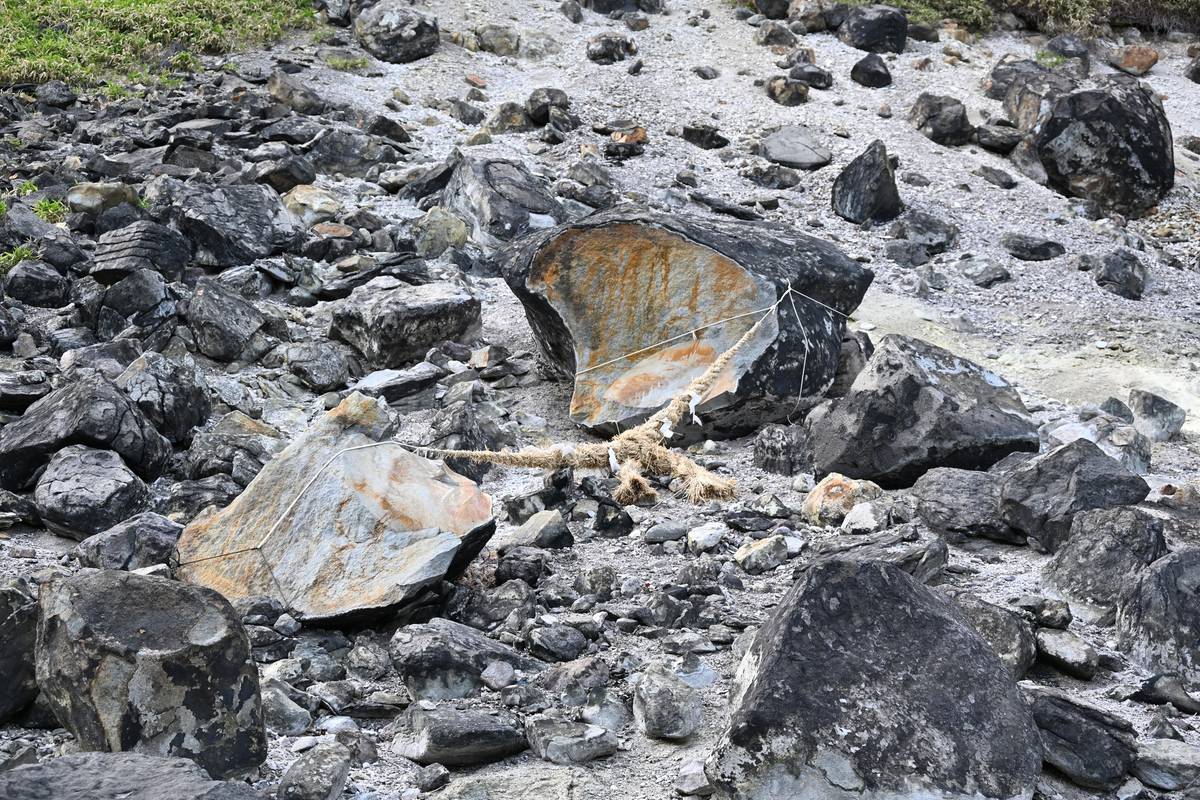
The shrine and the stone sit on the same stretch of ground. A path leads down from the grounds to Sai no Kawara, an area likened to the riverbed where the souls of the dead are said to pile up stones. As the smell of sulfur grows stronger, the plants thin out and gray rock and stacked stones spread in every direction.
The walk to the Sesshō-seki, hung with the thick shimenawa rope that marks sacred ground, takes about ten minutes at an easy pace. The stone split in two in March 2022 and is still enshrined in its broken state.
Volcanic gas seeps up throughout the Sai no Kawara area. Access is restricted when the concentration is high, so follow the signs on site.
The shrine, the Sesshō-seki, and Shika no Yu, the bathhouse at the center of the legend of the spring's discovery. All three sit within a few minutes' walk of one another.
Visiting
The address is 182 Yumoto, Nasu Town, Tochigi Prefecture.
The charm counter is open from 9 a.m. to 4 p.m. Goshuin here are given out only as kakioki, sheets written in advance rather than brushed into your book on the spot. Three are available, for Nasu Yuzen Shrine, Kyūbi Inari Shrine, and Nasudake Shrine, the inner shrine at the summit of Mount Chausu (as of August 2026).
There is a prefectural parking lot with 30 spaces below the great torii gate, and you can also park on the shrine grounds and on the Sesshō-seki side. All of them are free. Car navigation systems sometimes fail to guide you to the shrine itself, so the safest approach is to pull into the prefectural lot as soon as the great torii comes into view.
By car it is about 30 minutes from the Nasu interchange on the Tōhoku Expressway, heading toward Nasu Yumoto. Roads ice over in winter.
〒325-0301 182 Yumoto, Nasu, Nasu District, Tochigi
Loading map...
Open grounds with no fixed opening hours.
Hours verified August 2026
Stories about this place
Discover stories and insights about Nasu Yuzen Shrine
Last Updated: