What is Keikoya? Akane-banashi's Kaisei Arakawa Performs a Classic Rakugo Story
In episode 2 of the Akane-banashi anime, Kaisei Arakawa, a disciple of Issho Arakawa, performs Keikoya. Kaisei is a skilled young performer whose strength lies in his "sensual charm". This article looks at why this particular piece was chosen for his very first appearance, drawing on how the story is built and what sets it apart.
Akane-banashi is a manga written by Yuki Suenaga and illustrated by Takamasa Moue, and it has run in Weekly Shōnen Jump since 2022.
In Episode 2 of the anime, Kaisei, an apprentice of Issei who is the top of the Arakawa school, performs Keikoya. We will take a closer look at the appeal of this classic rakugo story and the reasons it is regarded as a particularly difficult piece to master.
Keikoya, a Classic Rakugo Piece That Calls for Extra Skills
This is a piece whose protagonist is a man who attends a keikoya (a practice studio that teaches traditional performing arts such as song and dance), with many elements of ongyoku (pre-modern Japanese music) woven throughout the story. Versions exist under the same title but with differing content and endings (sage).
Version 1, the Telling With a Memorable Practice Scene
This is the version Kaisei performs in the series.
At the time, lessons in the refined arts were something daughters of merchant families often took up so that they could go into service at a samurai household. The man at the heart of this story, though, signs up for one reason only. He wants to be popular with women.
Of course, a halfhearted attitude gets him nowhere. Even while waiting his turn he listens with only half an ear, and when the teacher asks whether he would rather learn dance or song, he answers that he wants the kind that will make him good at romance. She turns him down, saying that romance is “shinan no hoka”, something beyond what she can teach. The line is a play on words. Shinan, meaning instruction, sounds the same as shian, meaning forethought, so the phrase also says that romance is beyond all reckoning.
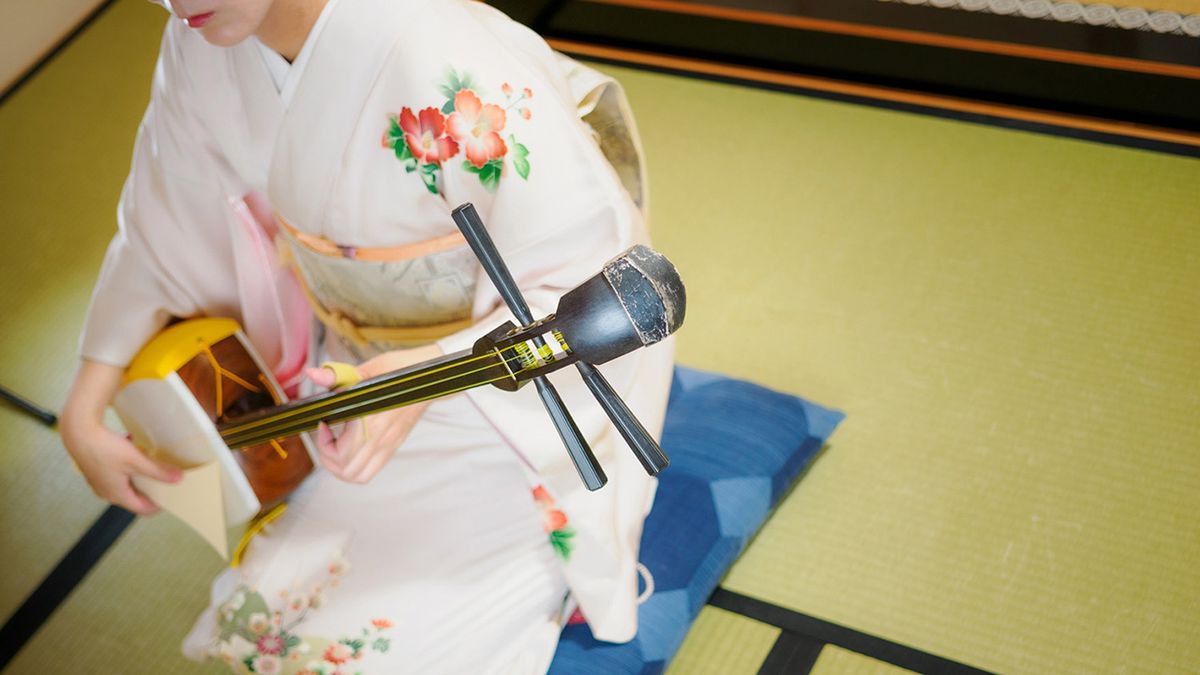
The practice scenes lean heavily on what is called geza ongaku, the offstage sound effects of kabuki theater, played from the wings of the stage on instruments like the shamisen, a three-stringed lute, and the taiko drum.
Version 2, the Telling Also Known as Utakaji
The man in this version is so dedicated that he climbs onto the roof of his house to practice his singing even after he has gone home for the day.
One windy night, he belts out the lyric "yaketatsu," meaning that something has burst into flame. A passerby mistakes it for a warning and asks where the fire is. When the man sings the next line, "umi yama koete," over seas and mountains, the passerby decides that if the blaze is that far off, there is nothing to worry about. That is the story's sage.
It is also known by the alternate title Utakaji.
Version 3, a Showcase of Musical Genres
In this one, a man taking lessons in shamisen music is taught a piece called Kisen, but he cannot remember it properly, and partway through it slides into a popular street-performer's tune. Next he learns a song called Gonjō, and the moment he sings it, it turns into a folk song.
There is no real punchline to speak of. What defines this version is how much ongyoku it incorporates.
What Makes Keikoya So Enjoyable
In Version 1, the highlight is the ongyoku woven through the practice scenes. The teacher’s elegant figure and real musical skill stands out, while her student, the man, sings his clumsy version of the same song. The gap between the two is what produces the humor.
The humor in version 2 hinges on the comic misunderstanding between the enthusiastic man and passersby. He sings at such a thunderous volume that strangers instinctively stop and ask, 'Where's the fire?!', mistaking his voice for an alarm cry. The joke lands with the misunderstanding never quite resolved, giving it the feel of a modern-day comedy skit.
Version 3 leans even further into ongyoku. The man is supposed to be learning what we might now call classical music, things like the background music of kabuki and nagauta, a style of song sung to shamisen accompaniment. Instead it keeps sliding into the pop music of its day, the tunes of street performers and folk songs. If you've ever caught yourself humming a song you just learned, only to realize you've somehow drifted into a completely different tune, you would find the story relatable and comedic.
Comparing Performances of Keikoya
This is the Keikoya that Kaisei performs in the series.
This is a set performed by Katsura Bunza. In it you can see a Keikoya whose lessons center on dance rather than singing.
Published Last Updated
Related Articles
Explore more articles on similar topics and deepen your knowledge of Japan.