The remains of Shibata Castle sit in the center of Shibata, a city in Niigata Prefecture. In the Edo period this area was the Shibata domain, the territory of a daimyo lord. The castle was the heart of the domain, and the Mizoguchi family served as its lords for 12 generations. The castle is also known by the names Ukifune Castle and Ayame Castle.
There is no main keep. That role fell to a building called the Sangai-yagura, the three-story turret. A yagura is a castle building used both for keeping watch and for storage. The roof on the Sangai-yagura at Shibata Castle is unlike any other in the country.
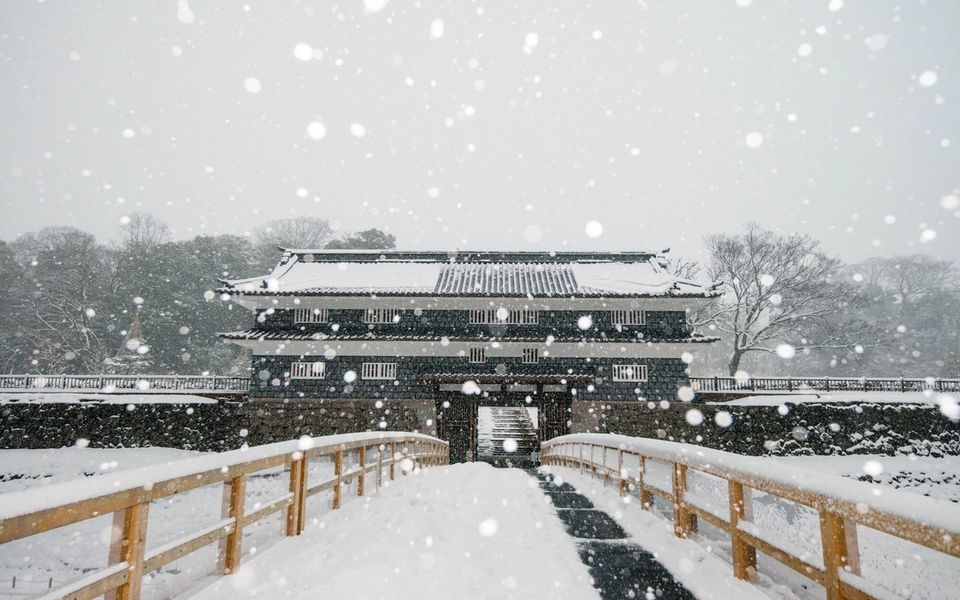
The grounds are open from April through November. Admission is free, and the walk from JR Shibata Station takes about 20 minutes.
Three Shachihoko on a T-Shaped Roof
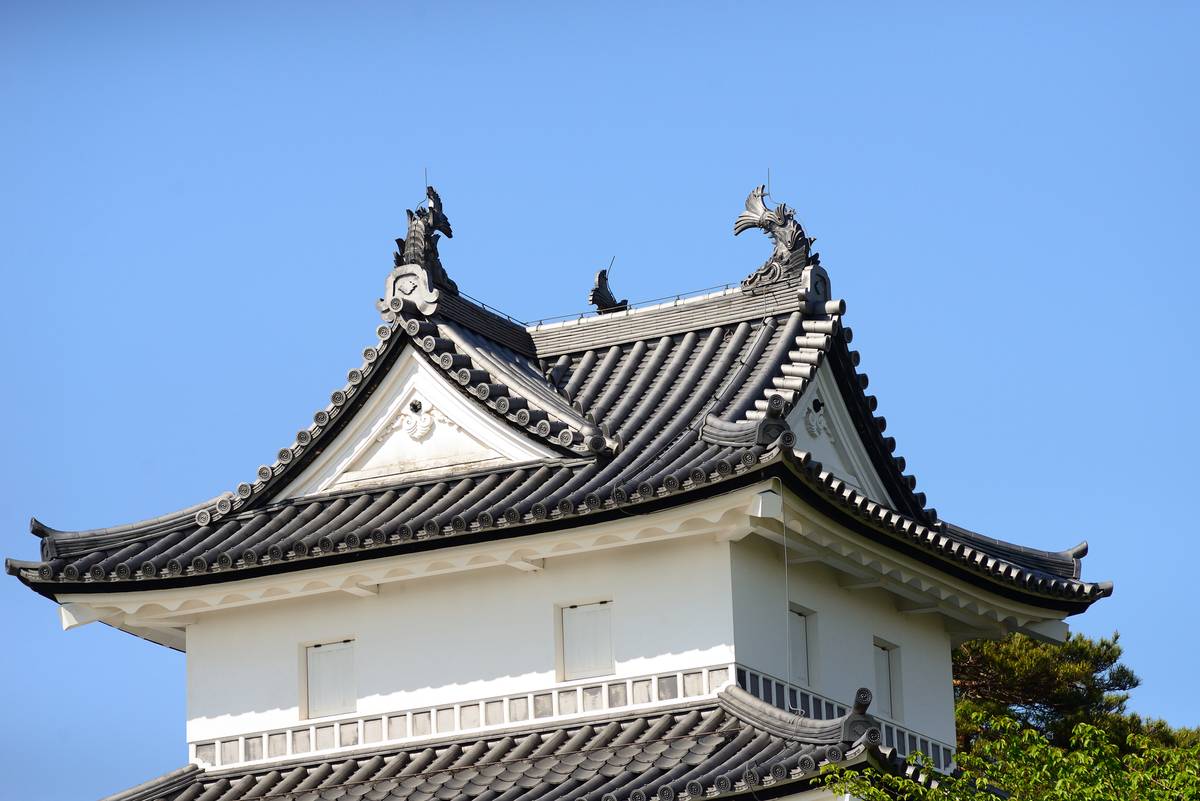
The roof of the Sangai-yagura is framed in the shape of a T. Three shachihoko sit on that roof. A shachihoko is an imaginary fish placed on a roof as a wish for protection from fire, and the custom is to set one at each end. This is the only turret in the country with three. A castle with no keep is known for a turret rarer than a keep.
The Sangai-yagura standing today is not the Edo-period building. It is a reconstruction from July 2004. The Tatsumi-yagura in the Honmaru was reconstructed the same month.
You cannot get close to the Sangai-yagura, though. It stands inside the grounds of the Japan Ground Self-Defense Force's Shibata camp. The restriction covers only the Sangai-yagura. The Tatsumi-yagura is inside the castle park.
A Castle the Mizoguchi Family Ruled for 270 Years
Mizoguchi Hidekatsu arrived in Shibata in the New Year of 1598. He was a daimyo who had been moved to Echigo, the province that is now Niigata Prefecture. Work on the castle began the same year. Hidekatsu set up a residence outside the castle and lived there while the construction went on.
The castle took about 50 years to take shape, under Mizoguchi Nobunao, the third lord of the domain. By 1646 the main turrets and gates were in place across the Honmaru, the Ninomaru and the Sannomaru, the enclosures ringed one outside the next, moving out from the center. The Honmaru Tatsumi-yagura was finished the following year, in 1647, and the Honmaru Shoin in 1654.
A great fire in 1668 burned down most of the buildings, sparing the Teppo-yagura and the Ushitora-yagura. Eleven years later, in 1679, the Sangai-yagura went up on the burned ground in place of a keep.
The Mizoguchi family ruled Shibata for 12 generations and about 270 years. Most daimyo of the Edo period were moved from one territory to another on the shōgunate's orders, but the Mizoguchi reached the Meiji Restoration without ever being moved.
In 1871, when the Meiji government abolished the domains and set up prefectures, the castle came to the end of its role. An army unit moved onto the site. In 1874 the timbers of the demolished castle were put back together to build the Shirakabe Heisha barracks. It was a two-story wooden building with the techniques of a Japanese castle layered over a French-style design, and its floor area was about 1,600 square meters.
After the war, a National Safety Forces unit moved here from Kanazawa in 1953, and since 1962 the Japan Ground Self-Defense Force's 30th Infantry Regiment has been stationed here. A corner of the castle site is still in use as a camp.
The Gate and Turret That Remain from the Edo Period
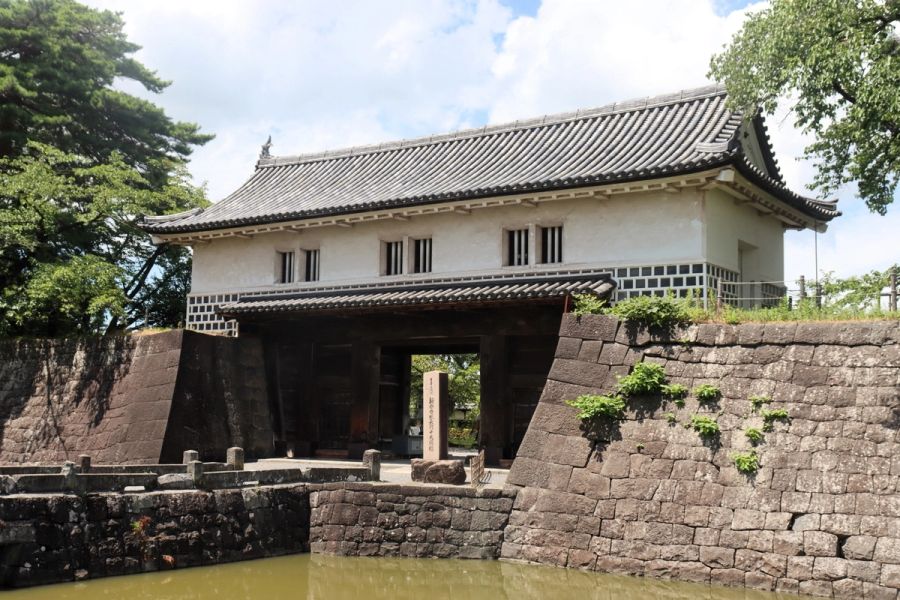
Two Edo-period buildings remain on the castle grounds, the Omote-mon main gate and the Kyu-Ninomaru Sumi-yagura, the old Ninomaru corner turret. Both date from the middle of the Edo period, and in 1957 the national government designated both of them Important Cultural Properties. An Important Cultural Property is a building or work of art that the national government has decided should be protected.
A bronze statue of Horibe Yasubei stands in front of the Omote-mon main gate. Born in Shibata, he is known as one of the forty-seven ronin who avenged their lord.
The castle park is planted with 360 cherry trees. Since it opens in April, a visit in spring brings the blossoms together with the turrets and gates.
Shibata Castle is also number 31 on Japan's 100 Fine Castles, a list compiled by the Japan Castle Foundation.
Visitor Information
The address is 6-chome Otemachi, Shibata, Niigata Prefecture. The grounds are open from April through November, from 9 a.m. to 5 p.m. In November alone they close at 4:30 p.m. (as of September 2026).
Admission is free and no reservation is needed. From December to March the site closes for the winter, and during that time only the exteriors can be viewed.
The Kyu-Ninomaru Sumi-yagura is closed to entry for part of the season while it undergoes conservation repairs. From July 24 to November 30, 2026, no one can go inside. The work itself runs until February 5, 2027.
There are two parking lots, both free. The castle park lot holds 10 standard cars and five large vehicles, and the lot at Ines Shibata, a short distance away, holds about 100 standard cars.
Shibata Station, where the JR Uetsu Main Line and the Hakushin Line meet, is about a 20-minute walk away. By car it is 15 minutes from the Seiro-Shibata interchange on the Nihonkai-Tohoku Expressway.
Shimizu-en and the Ashigaru-nagaya are a seven-minute walk from Shibata Station. Shimizu-en is a daimyo garden chosen as a Place of Scenic Beauty by the national government, and the Ashigaru-nagaya next to it is the housing where low-ranking samurai lived. That building is a nationally designated Important Cultural Property as well. Admission is 700 yen for adults and 300 yen for elementary and junior high school students, and both are close enough to the castle to walk between them (as of September 2026).
Appears in the Manga and Anime Nippon Sangoku
Nippon Sangoku is a manga in which three nations fight over a future Japan where civilization has collapsed.
The castle where Seii, one of the powers in the story, stays is said to be modeled on Shibata Castle, and it appears under the name Shibata Drill Castle.