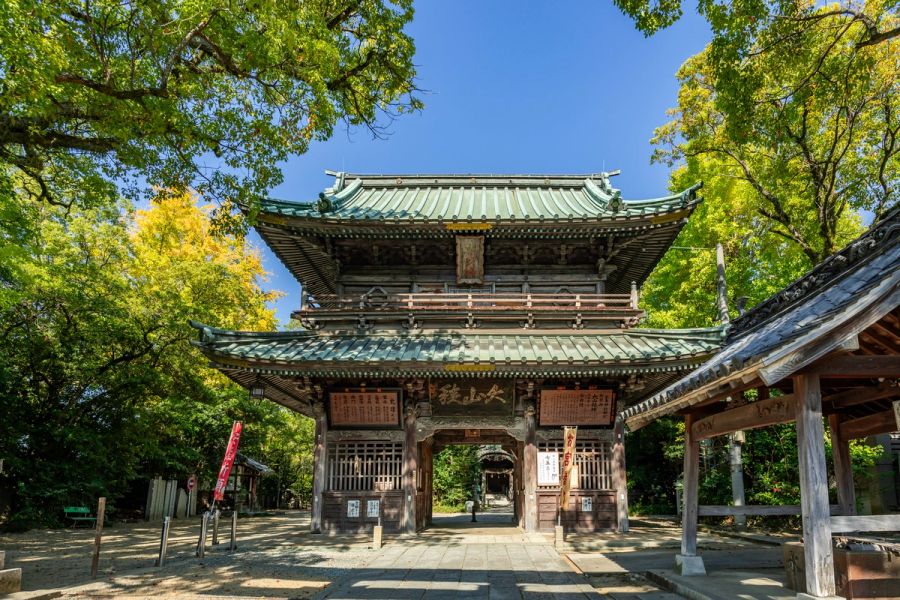
Mishima Shrine sits in the urban center of Shikokuchūō, an ancient shrine of the Uma region not far from the Seto Inland Sea. According to shrine tradition, it was founded in 720, the fourth year of the Yōrō era. The local name Iyo-Mishima comes from this shrine. It enshrines the mountain god Ōyamatsumi and has long drawn the devotion of the local community.
Visiting Information
Origins and the Name of the Land
In the early Nara period, Ochi Tamasumi was appointed governor of Uma District. He set up his residence at Kamigashiwa (now Kamigashiwa-chō in Shikokuchūō) and ruled the district from there. For years he made monthly pilgrimages to Ōyamatsumi Shrine on the island of Ōmishima, but as he grew older the journey became too much. On the 23rd day of the 8th lunar month in 720, the fourth year of the Yōrō era, he formally invited the spirit of Ōyamatsumi to be enshrined here.
According to the shrine's records, this is how Mishima Shrine began. From then on, the area was known as Mishima, and later as Iyo-Mishima. The name of the former Iyo-Mishima City also traces back to this shrine.
The Enshrined Deities
The principal deity, Ōyamatsumi, is known as the god of mountains and has long been revered as a guardian of the sea as well. People who work in the forests, on the land, and at sea have worshipped him for the peace of their daily lives. Sharing the main hall are the water deity Takaokami, along with Kamitsuhime, Shimotsuhime, and the thunder god Raijin.
The Zuijinmon Gate and Main Hall
The oldest structure on the precincts is the Zuijinmon Gate, built in 1821, the fourth year of the Bunsei era. In 1962, it was designated a cultural property of the former Iyo-Mishima City, together with the original main hall. It still stands at the entrance to the approach, looking much as it did two centuries ago.
The Annual Grand Festival
The largest event of the year is the annual grand festival in June, held each year on the Saturday and Sunday closest to June 15th. Parishioners and devotees gather to pray for the safety of the community, the prosperity of local industries, and the well-being of future generations.
A Pilgrimage Site for Nippon Sangoku
The gate that appears in the wedding scene in Episode 1 of Nippon Sangoku is modeled on the Zuijinmon Gate here. Since the manga's anime adaptation began airing in 2026, the shrine has drawn a new wave of younger fans visiting on pilgrimages to the series' locations.
Getting There
The closest station is Iyo-Mishima on the JR Yosan Line, and the shrine is within walking distance in the heart of town. The surrounding streets preserve the old townscape of the former Iyo-Mishima area, making it easy to combine a visit with a stroll through the neighborhood.