Kanazawa Castle Park stands on the site of the castle where the Maeda family lived, the family known for Kaga's million koku. The Kaga domain was the land the Maeda ruled in the Edo period, and the phrase comes from its kokudaka, the rice yield by which a domain was measured, which came to a million koku. The main keep is still gone, but stone walls and reconstructed buildings stand across the broad grounds. Walking the grounds costs nothing.
The only areas with an admission fee are the interiors of the reconstructed Hishi-yagura Turret, Gojikken-nagaya Storehouse, Hashizume-mon Tsuzuki-yagura Turret and Hashizume-mon Gate. A yagura is a castle building that doubled as a lookout post. Admission is 320 yen for adults and 100 yen for children aged 6 to under 18 (as of September 2026). The Kahoku-mon Gate and the Nezumita-mon Gate, also reconstructions, are both free to enter.
From Kanazawa Station, the Right Loop of the Kanazawa Loop Bus reaches the Kenrokuen Garden / Kanazawa Castle Park stop in about 18 minutes. The Ishikawa-mon Gate is right by the stop, and you enter the park there. On the east side, Ishikawa-bashi Bridge connects the park with Kenrokuen Garden, the garden next door. Across the bridge is the Katsurazaka Gate of Kenrokuen Garden.
White Walls and Lead Tiles
A white-walled building runs in a straight line along the top of the stone wall. It is one continuous structure, reaching from the Hishi-yagura Turret through the Gojikken-nagaya Storehouse to the Hashizume-mon Tsuzuki-yagura Turret. The roofs are laid with tiles made of lead. That is a feature shared by the buildings of Kanazawa Castle.
The lower part of the walls has a finish called namako walls. Square flat tiles are set side by side, and the joints between them are built up into thick ridges of white plaster. Around the Ishikawa-mon Gate and Tsurunomaru, gun loopholes are hidden behind this namako finish. Loopholes are small openings for firing arrows and guns, and from outside there is no telling where they are. In an emergency the tiles would be broken through and the guns fired from behind them.
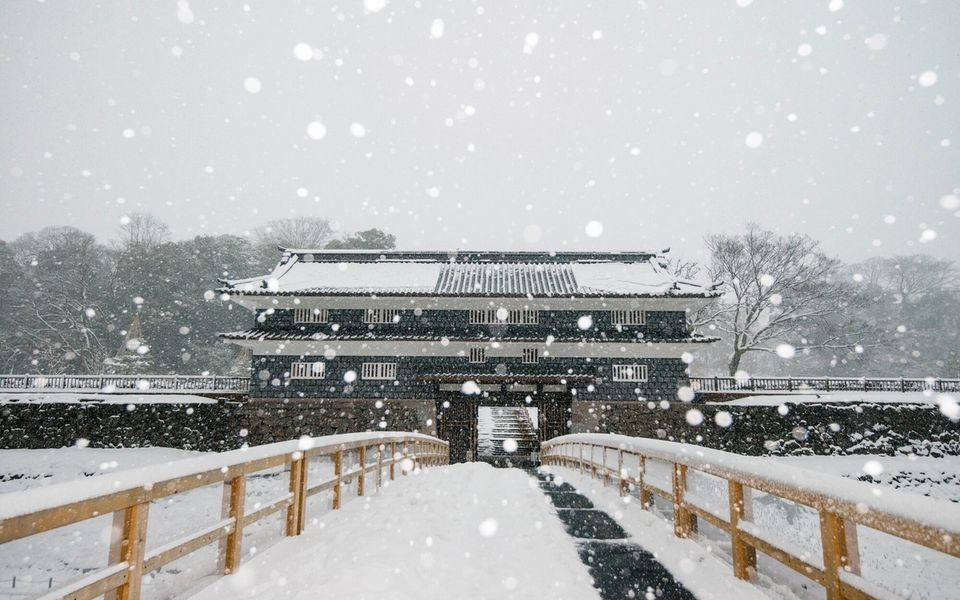
The exception is the Nezumita-mon Gate on the west side. On this gate alone, the joints of the namako walls are finished in black plaster. Set beside the other gates and turrets, which all use white, the difference in color is easy to see.
Three Buildings That Remain from the Edo Period
Most of the buildings in the park are recent reconstructions, but three remain just as they were in the Edo period. All three are nationally designated Important Cultural Properties.
The Ishikawa-mon Gate, which stands at the entrance facing Kenrokuen Garden, was rebuilt in 1788. It is laid out as a masugata, a square enclosure between two gates, and the plan was meant to stop attackers in their tracks. Only here and at the Ote-mon main gate of Osaka Castle does a masugata group of buildings remain in its Edo-period form. In 1950 it became a nationally designated Important Cultural Property.
The Sanjikken-nagaya Storehouse was rebuilt in 1858. It measures about 5.3 meters across and about 48.2 meters long. Its white wall runs in a long, narrow line along the edge of the stone wall. The building served as a store for weapons and equipment and as a defensive wall at the same time. It has been a nationally designated Important Cultural Property since 1957.
The Tsurumaru Storehouse is an earthen-walled storehouse built in 1848. Walls of this kind are packed thick with earth and plaster, and among such storehouses standing inside a castle this one ranks with the largest in the country. Its total floor area is 636 square meters. It became an Important Cultural Property in 2008. The parts damaged by the earthquake that struck the Noto Peninsula in Ishikawa Prefecture in January 2024 were repaired through 2025.
A Castle Still Under Reconstruction
In 1583 Maeda Toshiie entered Kanazawa Castle. The main keep burned in a lightning strike in 1602 and was never rebuilt. In its place, a three-story turret took on the role of the keep. In 1759 a great fire in the castle town burned the whole castle.
With the Meiji era, the castle grounds passed to military control. This was from 1871, and army barracks were set up inside the castle. In 1881 a fire that started within the grounds burned the Ninomaru and other buildings.
After the war the castle grounds were a university campus. Kanazawa University opened here in 1949, and until it finished moving to the suburbs in 1995 students went to class ringed by stone walls. Work to lay out the site as a park began in 1996.
In 2001 the Hishi-yagura Turret, the Gojikken-nagaya Storehouse and the Hashizume-mon Tsuzuki-yagura Turret were reconstructed and opened to the public. The Hishi-yagura Turret takes its name from its shape, a rhombus in plan with angles of 80 and 100 degrees. Even the pillars were cut to that rhombus shape, a painstaking job, and you can see the frame up close inside. The Kahoku-mon Gate was finished in 2010, and the Hashizume-mon Gate and Gyokusen'inmaru Garden in 2015.
In 2020 the Nezumita-mon Gate and Nezumita-mon-bashi Bridge returned. They had been lost in a fire in 1884, so the reconstruction came about 140 years later. The bridge is 32.6 meters long, the largest wooden bridge in the castle. It links Gyokusen'inmaru with the Kanaya-demaru, which is now the grounds of Oyama Shrine.
In the Noto Peninsula earthquake of January 2024, stone walls in the park collapsed in five places and were deformed in 23 others. The fallen stones have been surveyed and put into storage, and a panel of experts is still working out how to restore the walls. In July 2025 a viewing route was laid out in the grounds around the Imori-bori Moat.
Visitor Information
The address is 1-1 Marunouchi, Kanazawa, Ishikawa Prefecture. From March 1 to October 15, the park is open from 7 a.m. to 6 p.m., and from October 16 to the end of February from 8 a.m. to 5 p.m. There are no closing days (as of September 2026).
From 9 a.m. to 4:30 p.m., you can go inside the paid areas, the Hishi-yagura Turret, the Gojikken-nagaya Storehouse, the Hashizume-mon Tsuzuki-yagura Turret and the Hashizume-mon Gate. The ticket desk closes at 4 p.m. Admission is 320 yen for adults and 100 yen for children aged 6 to under 18. A combined ticket with Kenrokuen Garden is 500 yen (as of September 2026).
Entry is free at the Kahoku-mon Gate and the Nezumita-mon Gate, and their hours are the same as the paid areas. Visitors aged 65 and over get into the paid areas free as well by showing official identification. The same goes for holders of a disability certificate and one caregiver.
The Kanazawa Loop Bus leaves from the Kenrokuen exit of Kanazawa Station. The Right Loop takes about 18 minutes to the Kenrokuen Garden / Kanazawa Castle Park stop, the Left Loop about 25. By car, the Kenroku parking lot has 480 spaces for standard cars and the Hondanomori parking lot has 403.
The Tsurunomaru Rest House in the park is one of the checkpoints in the Nippon Sangoku digital stamp rally that the Ishikawa Prefecture Tourism League runs from May 26 to December 31, 2026.
Restoration of the stone walls that collapsed in the 2024 earthquake is still under way. Ishikawa Prefecture posts the progress of the work on its official website as it goes.
Appears in Nippon Sangoku
Nippon Sangoku, a manga about three nations at war in a future Japan where civilization has slid backward, was made into a television anime that aired in spring 2026.
In the story it appears as the castle where the army of Seii, one of the three nations, holes up.