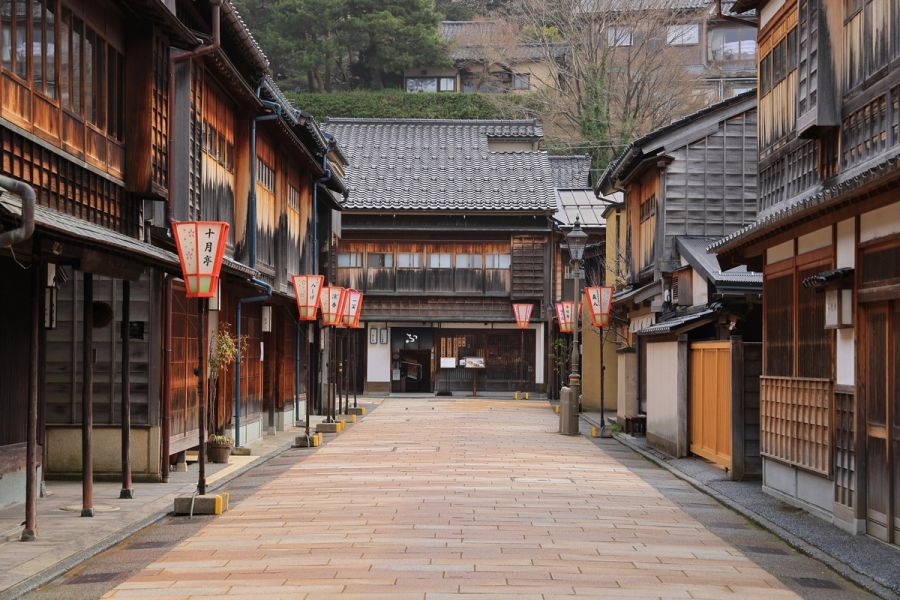
Higashi Chaya District is a teahouse district that the Kaga domain licensed in 1820. The Kaga domain belonged to a daimyo family that ruled Kanazawa in the Edo period, and Kanazawa flourished as its castle town. Along both sides of the stone-paved street stand buildings whose lattices are painted with bengara, a red pigment.
The townscape has been chosen as a nationally designated Important Preservation District for Groups of Traditional Buildings, a program that protects old buildings a whole district at a time. It was not rebuilt for tourism. Ochaya, the teahouses, are still in business here.
The Townscape That Began in 1820
In 1820 the Kaga domain gathered the teahouses scattered around the castle town into three places. They were divided into three districts, Higashi, Nishi and Kazuemachi, and Higashi grew to be the largest.
In Edo-period Kanazawa, two-story buildings were banned except for teahouses. A row of second floors along a street was in itself the mark of a teahouse district. Stand on the street today and look up, and the same buildings still stand in a row, tatami rooms built on the upper floor.
The fine wooden lattice set across the front of the first floor is called kimusuko. The red in the walls and the lattices comes from bengara, which has long been held to keep insects away and slow rot.
The designation came in November 2001. Its official name is the Higashiyama Higashi Preservation District for Groups of Traditional Buildings, and it covers about 1.8 hectares. Few teahouse districts have received this designation. Gion in Kyoto and Kazuemachi, on the far side of the Asano River, are the others.
Ochaya You Can Go Inside: Shima and Kaikaro
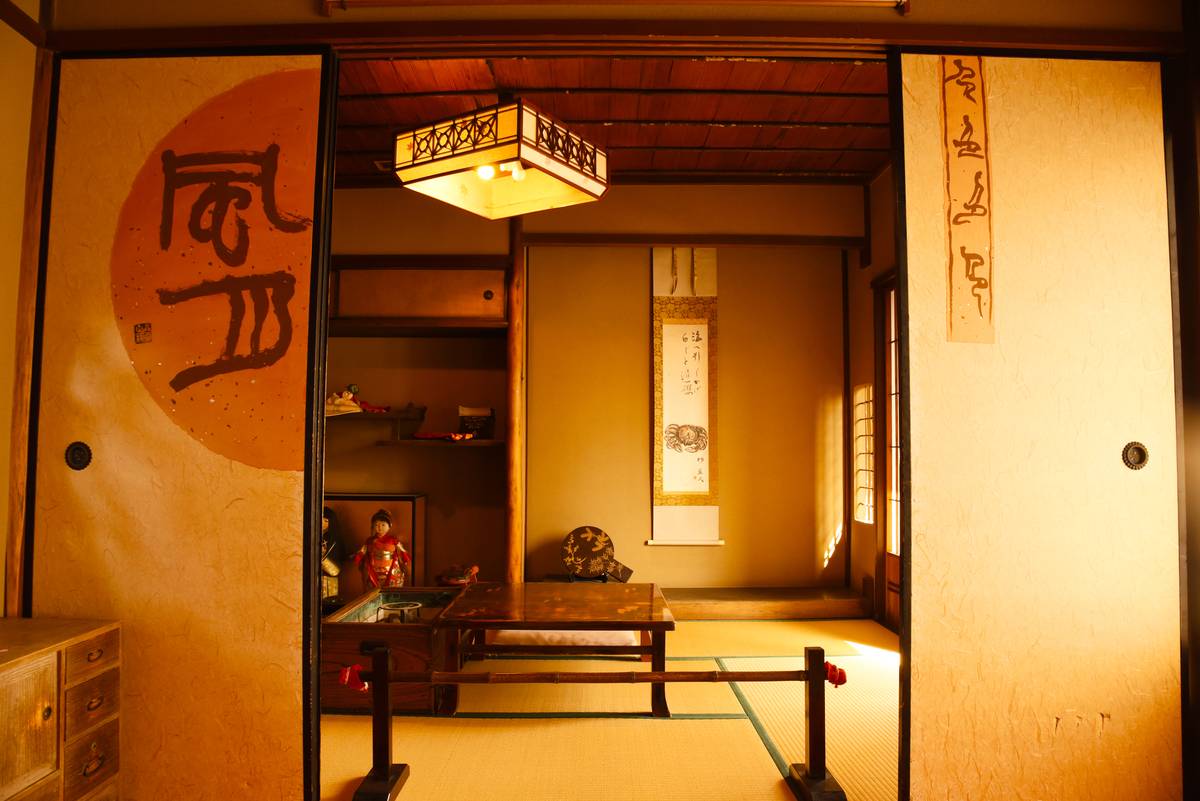
Two ochaya are open to the public inside. They are Shima and Kaikaro. Both let you see the tatami rooms and the furnishings, and each has a character of its own.
Shima is a teahouse built in 1820, the year the teahouse district was created. In December 2003 it became a nationally designated Important Cultural Property. It is a two-story building, with part of it rising to three stories. Kanson-an, a tea room in a separate building, serves matcha.
Admission is 500 yen for adults and 300 yen for junior high school students and younger. It is open from 9:30 a.m. to 5:30 p.m., closing at 5 p.m. in the winter months from December through February. There are no closing days (as of September 2026). Matcha at Kanson-an costs extra.
Kaikaro is a preserved building designated by the City of Kanazawa, and it is said to be among the largest Edo-period teahouse buildings in Kanazawa. One tea room has tatami woven with gold-leaf mizuhiki cord, and the staircase is finished in Wajima-nuri lacquerware, the lacquerware of Ishikawa. A hanayome noren, a bridal curtain dyed in Kaga Yuzen, the dyeing of Kanazawa, hangs there as well.
Admission is 750 yen for general visitors and 500 yen for elementary, junior high and high school students. It is open from 10 a.m. to 5 p.m., though the hours change when a banquet is booked. Closing days are irregular (as of September 2026). The cafe inside serves a sweet called ogon kuzukiri.
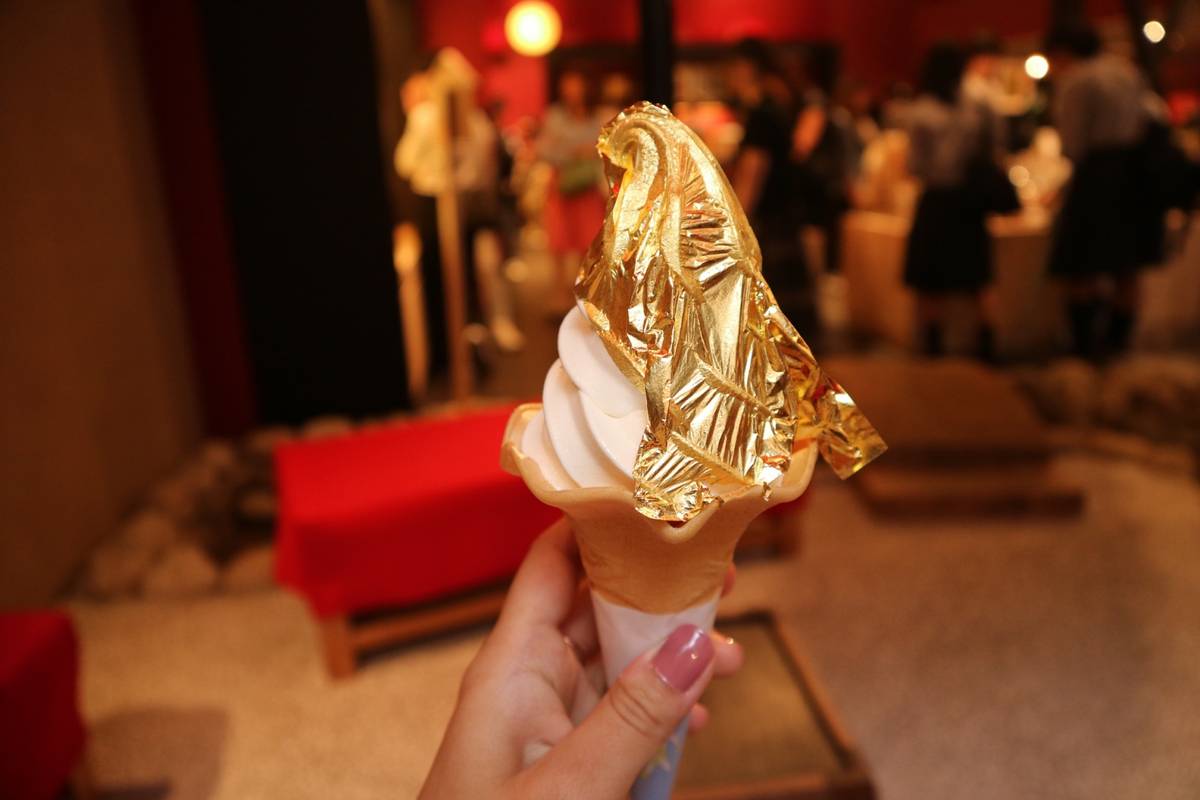
The standard snack to eat as you walk is soft serve ice cream topped with gold leaf. Kanazawa accounts for more than 98% of Japan's gold leaf production, and Higashi Chaya District has shops that deal in it.
Getting There and Getting Around
From the Kenrokuen exit of Kanazawa Station, take the Right Loop of the Kanazawa Loop Bus and get off at Hashiba-cho. Look for the red body of the bus. On foot it is about 2 kilometers, around 30 minutes.
Walking through the teahouse district to the bank of the Asano River takes about three minutes. Three bridges cross here, Asanogawa Ohashi Bridge, Umenohashi Bridge and Nakano Bridge, and Umenohashi Bridge is for pedestrians only. On the far bank is Kazuemachi Chaya District, which has also been chosen as an Important Preservation District for Groups of Traditional Buildings.
If you come by car, finding a parking space can take time. The Higashiyama tourist parking lot for regular cars is on the east side, and it fills up easily. There are several coin parking lots in the area as well.
The address is Higashiyama, Kanazawa, Ishikawa Prefecture. Walking the streets costs nothing. You pay admission only when you go into a place open to the public, such as Shima or Kaikaro.
Appears in Nippon Sangoku
The manga Nippon Sangoku draws this area under the name Higashiyama Inn District. In the story it is where the generals of Yamato take their lodging.
The Ishikawa Prefecture Tourism League is running the Nippon Sangoku Four Cities Tour digital stamp rally with the television anime Nippon Sangoku from May 26 to December 31, 2026. The Higashi Chaya Rest House is one of the five checkpoints in the prefecture.
The streets are open to walk at any time. Shima is open from 9:30 a.m. to 5:30 p.m., and until 5 p.m. from December through February. Admission is 500 yen for adults and 300 yen for junior high school students and younger, and there are no closing days. Kaikaro is open from 10 a.m. to 5 p.m. with irregular closing days, and admission is 750 yen for general visitors and 500 yen for elementary, junior high and high school students. When a banquet is booked, Kaikaro's public hours change (as of September 2026).