Yoyogi
代々木
Things to Do in and Around Yoyogi
Yoyogi in Shibuya is a verdant pocket of Tokyo centered on Meiji Jingū, a shrine with over a century of history, and Yoyogi Park, which spans roughly 54 hectares. Just beyond lies Harajuku and Omotesandō, where youth culture pulses and zelkova-lined shopping streets stretch out. Here, the forest's quiet and the city's energy exist side by side.
Places to visit in Yoyogi
Where is Yoyogi?
Yoyogi sits in the northern part of Shibuya, near the boundary with Shinjuku. Centered on Meiji Jingū and Yoyogi Park, the area extends south toward Harajuku and Omotesandō, east to Sendagaya, and west to Sangūbashi. From Shibuya Station it's about a 15-minute walk; from Shinjuku Station, just one JR stop away. The area enjoys an excellent location surrounded by Tokyo's major transport hubs.


Getting Around
Harajuku and Yoyogi stations on the JR Yamanote Line are the nearest, with access also available via Meiji-jingūmae Station on the Tokyo Metro Chiyoda and Fukutoshin lines, and Yoyogi-kōen Station on the Chiyoda Line. From Shibuya or Shinjuku, it's just a few minutes by train. Major attractions including Meiji Jingū, Yoyogi Park, Takeshita-dōri, and Omotesandō are all within walking distance of the stations. You can walk south from Omotesandō toward Shibuya, making it easy to combine visits to multiple neighborhoods in a single outing.
Loading map...
About Yoyogi
The forest of Meiji Jingū was nurtured from a hundred thousand donated trees. Yoyogi Park traces the contours of postwar history. Harajuku and Omotesandō pulse with young crowds. In this area, landscapes of different eras and characters stand side by side.
The Forest of Meiji Jingū
Dedicated to Emperor Meiji and Empress Shōken, Meiji Jingū has stood for over a century since its founding in 1920. The roughly 70-hectare forest surrounding it was deliberately planted with nearly 100,000 trees donated from across the country, put into the earth by more than 110,000 volunteer hands. What began as an artificial forest has gradually transformed into natural woodland over more than a hundred years. Every January, around three million people visit for hatsumōde, the first shrine visit of the new year, making it the most visited shrine in Japan.
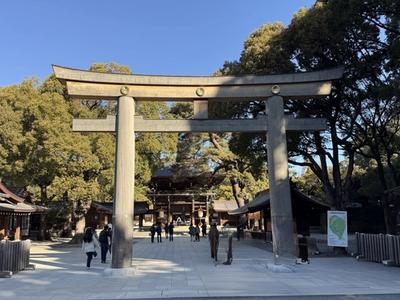
At the entrance to the approach stands the ōtorii, the grand torii gate. As a wooden myōjin-style torii, it ranks among Japan’s largest at 12 meters tall with 9.1 meters between the pillars. It was rebuilt in 2022 and stands with commanding presence. Beyond the gate, deeper into the forest, Kiyomasa no Ido holds still water between the trees. This well, said to have been dug by the Sengoku-era warlord Katō Kiyomasa, yields about sixty liters of water every minute, an inexhaustible spring.
Behind the main shrine stands the Meiji Jingū Gyoen, a garden laid out in the early Edo period. From late spring into early summer, roughly 1,500 hanashōbu in about 150 varieties bloom in succession, and grasses and flowers change with each season. Entry requires a modest donation of 500 yen, but as you walk along paths dappled with leaf-shadow, you might forget you’re in the heart of Tokyo.
Yoyogi Park
Yoyogi Park spreads across an area equivalent to about eleven Tokyo Domes. Its history is surprisingly layered. During the Edo period, it was the secondary residence of the Ii clan. In the Meiji era it became an army parade ground. In 1910, Japan’s first powered flight took place here. After the war, it became Washington Heights, the housing area for Allied occupation forces, and in 1964 it served as the athletes’ village for the Tokyo Olympics. It opened partially in 1967 and fully in 1971. Few parks hold so many eras folded together in one place.
Spring brings roughly five hundred cherry trees into bloom across the grounds. Somei Yoshino, Ōshima cherry, and yamazakura varieties flower at slightly different times, allowing blossoms to grace the park over an extended season. The Kawazu cherry arrives early, reaching its peak in the last weeks of February and the first weeks of March.
The event plaza hosts flea markets, local specialty fairs, and world food festivals with the seasons, drawing crowds on weekends. Surrounded by more than ten thousand trees, the park offers a rare refuge from the pace of the city.
Harajuku and Omotesandō
Harajuku, which borders the entrance to Meiji Jingū’s approach, is known as a wellspring of youth culture. Takeshita-dōri stretches roughly 350 meters and crowds about 130 shops into its length. From 11 a.m. to 6 p.m. daily, no vehicles are allowed; it becomes a pedestrian paradise where distinctive fashion boutiques and sweets shops vie for space. In the 1970s and ’80s, a street dance movement called the Takenoko-zoku emerged in this district, with young dancers in flamboyant costumes moving through the crowds. Meanwhile, rockabilly enthusiasts gathered every Sunday in Yoyogi Park to dance. This freedom of expression helped nurture Harajuku into what the world now recognizes as the epicenter of “kawaii” culture.
The zelkova-lined avenue of Omotesandō was established as the approach to Meiji Jingū in 1921, with two hundred saplings planted the following year. The Great Tokyo Air Raids destroyed most of these trees, and of the roughly two hundred, only thirteen survived. The trees replanted after the war now number about 163 and thrive with each season, shifting the street’s character throughout the year.
Omotesandō Hills, which opened in 2006, was designed by architect Tadao Andō to respect the zelkova’s towering height of about 20 meters, keeping the building itself to just six stories above ground. In winter, 900,000 LED lights illuminate the 154 zelkova trees in champagne gold, enveloping the avenue in warm radiance. This illumination, which began in 1991, paused at one point, then resumed in 2009, and has become a fixture of Tokyo’s winter season.
Yoyogi National Gymnasium
Built to host swimming and basketball during the 1964 Tokyo Olympics, the Yoyogi National Gymnasium stands as a masterwork by architect Kenzō Tange. Its roof is suspended by cable structures, creating a vast interior space free of supporting columns. The design astounds viewers even after six decades. Designated a National Important Cultural Property in 2021, it endures as a keeper of Olympic memory and architectural innovation.