Nui-katsu
Meaning
Nui-katsu refers to activities centered on plush toys. It covers everything you might do with a favorite plush or a plush of your oshi (nui), from collecting them and taking them out with you to photographing them and dressing them up.
People often describe it as a branch of oshikatsu, the activities fans do for their oshi, but having a particular oshi is not a requirement. Heading out with a plush you fell for at first sight, or one you have kept close for years, and changing its outfits counts as nui katsu just the same.
There are many ways to enjoy it. Beyond displaying a plush you have brought home, people carry them along to cafes and on trips to photograph them, which is called nui-dori, and dress them in outfits made for plush toys, known as nui-fuku. Several of these related activities have spread, each with its own term. Getting a new nui is called omukae (roughly to ‘bring home’), and the appeal lies more in enjoying living and going out together than just collecting them.
There is no official standard and the names vary, but plushes around 20 cm tend to be used for display, while ones around 10 cm or 15 cm are easier to carry around. Outfits for changing clothes are also easy to find in the latter two sizes.
Origin
The word nui-katsu was not coined by any one person. It spread when a familiar pattern of Japanese phrasing met the culture of appreciating plush toys.
The Evolution of “-katsu” Expressions
Japanese has a word-building pattern that shortens the word for an activity into "-katsu." Examples include shu(就)katsu from ‘shushoku katsudo’ for job hunting, konkatsu for searching for a marriage partner, asakatsu for making use of the morning hours, and shu(終)katsu for preparing for the end of life. In each case the two characters for activity, katsudo (活動), are compressed into the single character katsu (活).
Oshikatsu, which refers to the activities of supporting one's oshi, also took hold as a word in this family. Nui-katsu, also a part of oshikatsu, shortens nuigurumi katsudou into "-katsu" form. Because the pattern was already familiar, the word easily gained acceptance.
How Social Media and the Plushie Market Fueled the Trend
Sharing photos on social media pushed nui-katsu into wider recognition. More people began posting pictures of plushes they had taken out or pictures of dressed up nui on X and Instagram, and people with the same hobby connected with one another through the images.
Demand for plush toys themselves has been growing too. According to the Japan Toy Association's fiscal 2023 survey of the toy market, the plush toy market reached 39.1 billion yen, which is 120.7 percent of the previous year's figure. More companies are officially selling plushes of popular characters, widening the options for omukae.
Nui-katsu was nominated for U-Can's 2024 New Words and Buzzwords Awards. It did not win, but being nominated shows it had spread enough to be a candidate.
Usage Examples
- 1 This weekend I took my favorite plush along and did some nui-katsu at a new cafe.
- 2 This nui-fuku fits perfectly and it's so cute. With a 10 cm plush, clothes are easy to find, which is nice.
- 3 I finally managed to omukae one from the restock. I can't wait for it to arrive.
- 4 I had my plush in a nui-ba while I was out, and someone who seemed to be a fan of the same oshi came up to talk to me. It made my day.
Supplement
What nui-katsu involves varies from person to person. A common form is carrying a nui out to spend time together, bringing it along to cafes, travel spots, and event venues.
Taking photos once you are out is called nui-dori. Many people pay close attention to the background and props, and posting the photos on social media is a staple part of it.
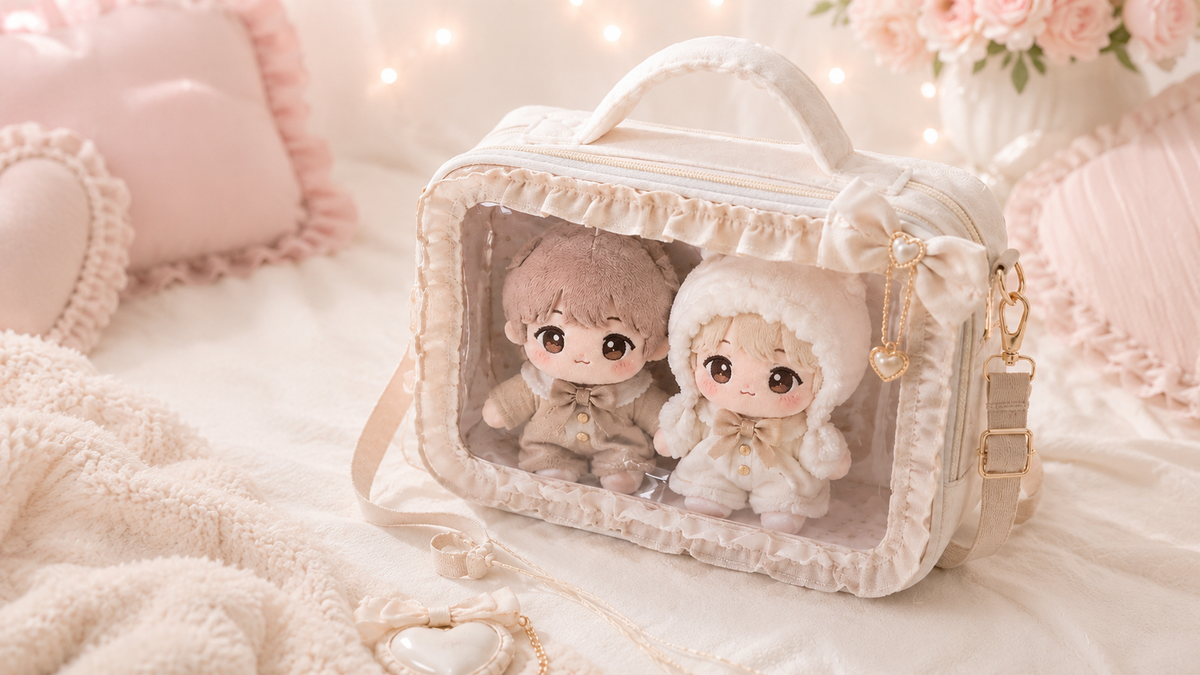
An example of a nui-ba
Dressing a nui in outfits made for it, called nui-fuku, is popular too, with some people buying ready-made clothes and others sewing their own. For carrying it around, people often use a bag with a clear window that keeps the nui’s face visible, known as a nui-ba.
Why it Caught On
It suits social media well. Since you can post with the nui standing in for you rather than showing your own face, the psychological hurdle of sharing photos is low.
It lets you act out forms of connection you cannot have directly with a favorite character or oshi, channeled through a nui. Going out together, dressing it up, and capturing it in photos become ways to feel closer to what you love.
It also works as a marker between people supporting the same oshi. Posts of an oshi nui tucked in a nui-ba or of nui-dori shots become a chance to meet other fans of the same oshi, serving as a doorway into connecting with them.
Differences Between Japanese and English-Speaking Plushie Culture
In the English-speaking world too, there are people who enjoy carrying plushies around and photographing them.
What sets Japan's nui-katsu apart is that it has been organized into a single activity, complete with surrounding terms like nui-dori, nui-fuku, nui-ba, and omukae. Each way of enjoying it, whether photographing, dressing it up, or carrying it with you has its own name, and the vocabulary spread as a set. That is where the Japan-specific distinction lies.
Last Updated
Japanese
ぬい活
Hiragana
ぬいかつ
Table of Contents