Japan Tax-Free Shopping
Japan's consumption tax exemption is changing to a refund system, where you get the money back later, for purchases made from November 1, 2026. This page lays out how the process works under both the old and new rules, who qualifies, how otaku goods shops handle tax-free shopping, and what to watch out for at the airport.
This guide is for international visitors. Residents of Japan are not eligible for tax-free shopping.
Short-term visitors shopping in Japan can shop free of the consumption tax (10%, or 8% on food and drinks) if they meet the conditions.
More importantly, the way this tax exemption works is changing on November 1, 2026.
Japan's Tax-Free System Changes on November 1, 2026
To put the change simply, what used to be "you pay less on the spot" becomes "you get the money back later."
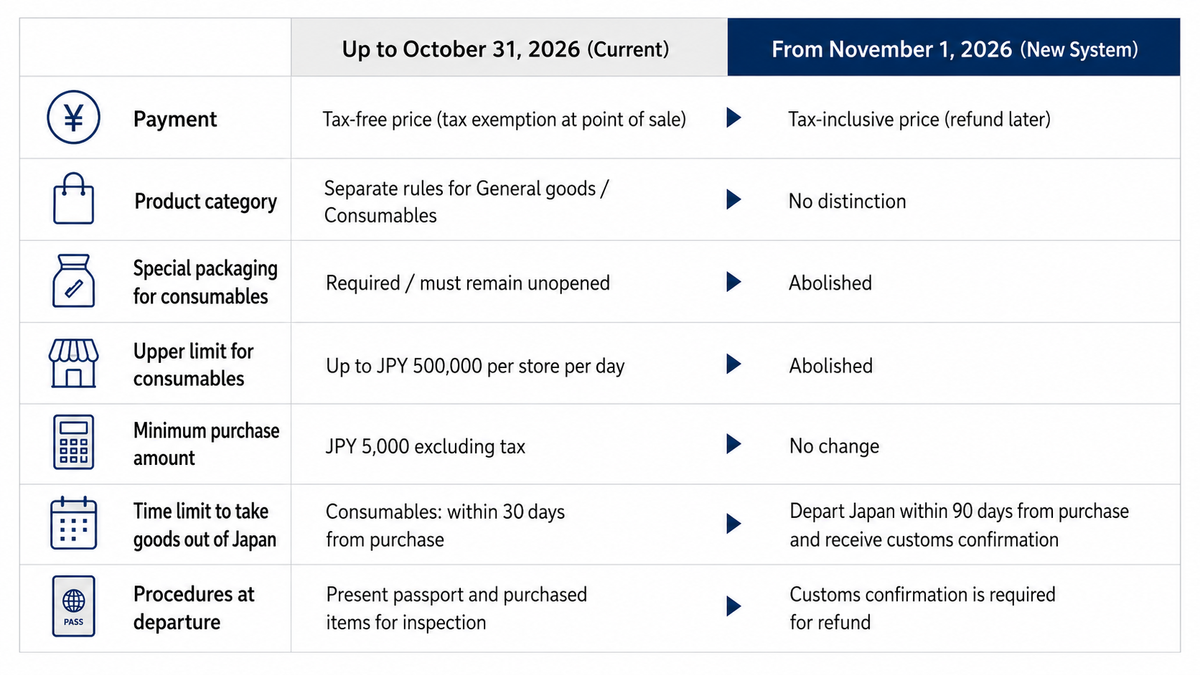
The current system deducts the consumption tax when you pay. For purchases made on or after November 1, 2026, Japan switches to a refund system: you pay the full price with tax, and the tax amount comes back after your departure is confirmed.
The purpose is fraud prevention. Tax-free goods bought in Japan were being resold domestically.
Verified as of July 28, 2026
If your trip runs across October 31, anything you buy in October falls under the current rules and anything you buy from November onward falls under the new ones, so you'll go through both procedures separately when you leave the country.
If you have some flexibility on when you shop, you could plan around it by saving your snacks and other consumables for November onward, when the sealed bags are no longer required.
Who Can Use the Tax Exemption
Before getting into the steps, check whether you qualify in the first place. There are three cases that do.
- A foreign national with "Temporary Visitor" status, within 6 months of entering Japan
- A cruise passenger (with a ship tourism landing permit)
- Japanese nationals living abroad (non-residents), provided you can prove you've lived overseas for two years or more with a certificate of residence abroad or a copy of your family register's supplementary record
The residence certificate or koseki no fuhyō must show your registered domicile down to the lot number, and must have been issued no earlier than six months before your most recent entry into Japan.
The residence certificate can be issued as an e-certificate if your embassy or consulate supports online applications, but some stores ask for a paper document, so printing it out and bringing it with you is the safe move.
For purchases made from November 1, 2026, you'll also be able to use a My Number card showing that you've moved abroad, including the smartphone version, and you'll no longer need to have your permanent domicile listed on it.
Work visa holders, anyone past 6 months in Japan, and residents of Japan are not eligible. The procedure requires your physical passport. Copies and phone photos are not accepted.
You'll also need the entry stamp in your passport, or the landing permission seal, to go through the tax-exemption process. Automated gates don't stamp your passport, so if you're planning to shop tax-free, ask the staff right there for a stamp as soon as you've passed through the gate. You can't get one added later.
What You Can and Can't Buy Tax-Free
As a rule, only physical goods qualify.
Services such as hotel stays, restaurant meals, repairs, and maid cafe cover charges do not. The standard tax rate is 10%; takeout food and drinks are 8% (reduced rate). What you save is that tax amount.
It is not widely known, but secondhand goods sold by stores also qualify. Used-goods shops like Mandarake and Suruga-ya work too, as long as the store holds a tax-free shop license. The claim that used items don't qualify is incorrect.
What Doesn't Qualify
- Overseas shipping. The principle is "carry the goods out in your own luggage." Mailing them out yourself (separate shipping) was abolished at the end of March 2025, and whether a store can ship directly overseas depends on the store.
- Purchases for resale or other business purposes
- Certain items such as gold bullion
- Gacha capsules, Ichiban Kuji lottery draws, and crane game prizes (not a sales format that tax-free procedures can attach to)
Traveling Before October 31, 2026? The Current System
Now for the actual steps, starting with the current system, which runs through October 31.
Show your physical passport at the register. Stores that support it can shorten the procedure with the Visit Japan Web tax-free QR code (you still need to carry the physical passport).
You pay the price with the tax already deducted, and the store transmits the purchase record to the National Tax Agency automatically.
Goods fall into two categories with different rules.
General Goods
Figures, game consoles, books, doujinshi, clothing, electronics, and so on.
¥5,000 or more before tax, with no upper limit. You can open and use them while in Japan.
Consumables
Snacks, cosmetics, medicine, and so on.
¥5,000–¥500,000 before tax. They go into a designated sealed bag and must stay sealed until you leave Japan. Take them out of the country within 30 days of purchase.
Notes on Combining Purchases to Reach the Threshold
Some stores let you combine general goods and consumables to reach ¥5,000, but in that case the whole purchase follows consumable rules (sealed bag, 30 days).
At Departure: Just Show Your Passport
When you leave, show your passport at customs. The purchase records have already been transmitted, so that is basically it.
There are random checks of the actual goods, though, and if a sealed bag has been opened, you pay the consumption tax on the spot.
Keep the things you are taking home and the things you want to use right away clearly separated.
Traveling From November 1, 2026? The New Refund System, Step by Step
Roughly speaking, the new system comes down to three steps: you pay the full tax-included price at the shop, you get your purchases checked at the airport, and the money comes back to you afterward.
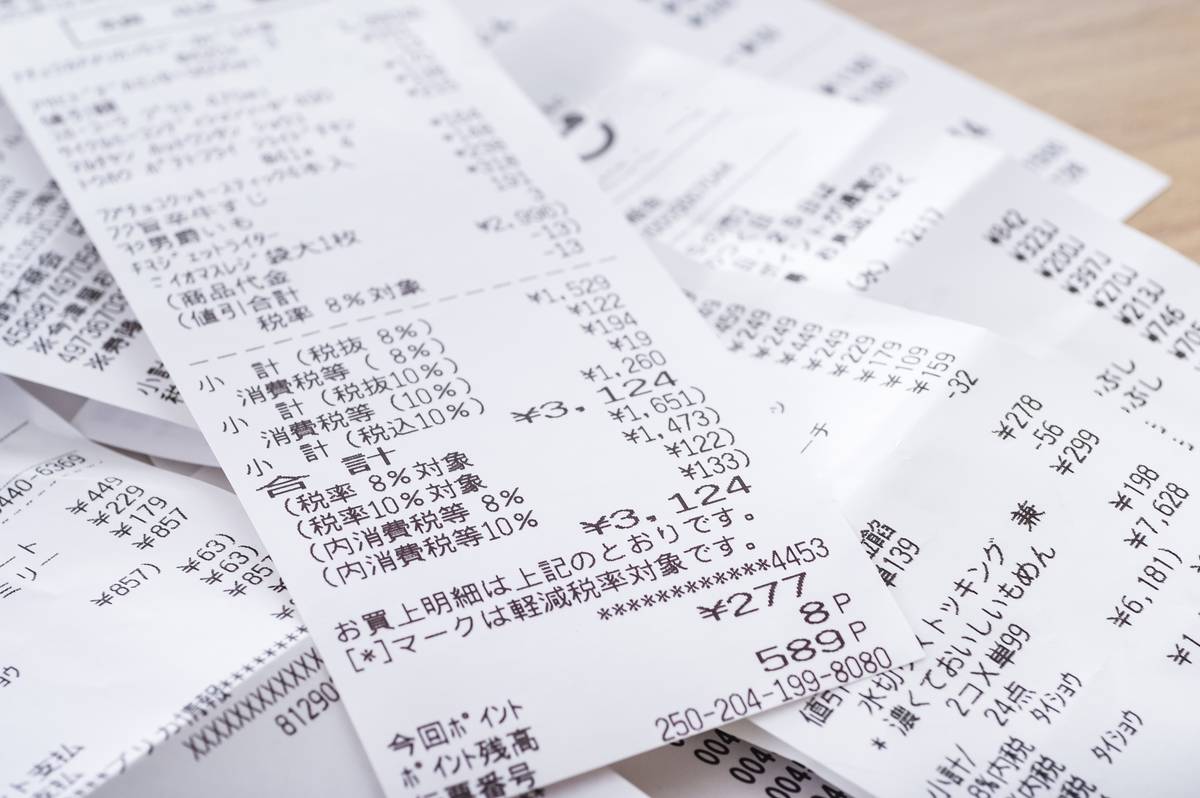
- Buy at the full price with tax:
Show your physical passport at any store with the red "Japan Tax-Free Shop" logo. The store registers the purchase in the system, and you pay the price including tax.
How you will receive the refund is also set up at the store at this point. The receipt is your only proof for the refund, so keep it safe. - Get checked at the airport:
Before checking in any bags, hold your passport up to a tax-free kiosk at the airport or seaport (it takes a few seconds).
Green means you are done. Red means you take the goods to the customs inspection area and show them. - Get refunded later:
The refund comes from the store you bought from (or a refund operator the store contracts).
Methods include bank transfer, a refund to your credit card, app-based transfer, and cash at the airport. Which method, and how soon you receive it depends on the store.
To get the refund, you have to leave the country and have customs verify your purchases within 90 days of buying them. Miss that window and the money doesn't come back. Anything that's been verified also has to be taken out of the country right away. If you don't take it with you, the consumption tax will be collected from you and you may face penalties on top of that.
A handling fee may be deducted, so you might not get the full amount back (the actual numbers are in "Is Tax-Free Worth the Hassle?" below).
There are upsides for shoppers, too. The product categories, sealed bags, and ¥500,000 cap all disappear, so snacks, figures, and manga combine under one rule, and you can open everything the day you buy it.
But anything you eat or use up cannot be shown at the airport, so they don’t qualify for refunds.
Tax-Free for Otaku Shopping
Now for the part most of our readers came for: how tax-free works at the stores that sell otaku goods.
These are the major otaku-goods retailers that offer tax-free shopping.
- Bic Camera / Yodobashi Camera
- Don Quijote
- Animate (select stores)
- Mandarake
- Pokémon Center (major locations)
- BOOKOFF (some large stores)
- Suruga-ya (select stores)
- Hard Off / Hobby Off (select stores)
For stores not on this list, look for the "Tax-Free" sign at the storefront. No sign usually means no tax-free, but some stores simply don't display one, so if a particular store matters to you, ask the staff.
Where Tax-Free Doesn't Work
Small doujin shops and secondhand stores usually don't offer it. Becoming a tax-free shop requires tax office approval and an electronic system for reporting purchase records, which is a heavy burden for independently run stores.
Tax-free also does not exist for the following purchases.
- Circle goods at doujin events (Comiket, etc.):
Circles are not tax-free shops. There is no tax-free procedure at the venue. - Gacha capsules and lottery draws like Ichiban Kuji:
Not a sales format that tax-free procedures attach to. - Crane game and arcade prizes:
These are prizes, not the sale of goods.
Practical Tips
For otaku shopping, the two things that trip people up are the amount and how you pay.
First, the amount. The ¥5,000 pre-tax line is the first hurdle. Doujinshi, manga, and single trading cards (TCG singles) are cheap per item and often fall short. Totals only combine at the same store on the same day, so the basic move is to pick one store and buy everything in one go.
Under the current system, books, doujinshi, and figures are general goods, so you can enjoy them during your stay. Just note that mixing in food like snacks makes the whole combined purchase subject to sealing (from November this problem disappears entirely).
Next, the checkout. At stores where the register and the tax-free counter are separate (Bic Camera, Don Quijote, and Mandarake, among others), it is a two-step process: pay first, then the counter.
The counter can close before the store itself does, so leave yourself time late in the day.
The Process at Airports
There is one important rule at the airport: finish the tax-free procedure before you check in your bags. Stick to that and nothing major should go wrong.
Current system (through Oct 31): show your passport at the customs counter. The records are already transmitted, so that is usually all. Random checks of the actual goods do happen. Keep sealed bags unopened.
New system (from Nov 1): the customs check itself is the condition for your refund, so everyone goes through the kiosk.
- The kiosks and the customs inspection area are in the international departures lobby, before you check your bags. Pack your tax-free purchases somewhere easy to reach in your suitcase.
- Once you check in a bag, you cannot get it back for the tax-free procedure. Items you plan to check in, like large figures, should be the ones you process first, then check in.
- The customs check works per receipt. If even one item on a receipt is missing, the whole receipt gets no refund. If something is missing because you ate or used it, skip the kiosk and tell the customs counter instead.
- If you sent your suitcase to the airport by courier, collect it at the airport counter first, then do the procedure. Sending it straight home or overseas makes the export check impossible, so there is no refund.
- For high-value items of ¥1,000,000 or more before tax per item, customs may ask to see an appraisal or warranty certificate.
You need to finish this before the boarding process. If you run out of time, neither the airline nor customs will compensate you. Right after the November switchover, queues will be unpredictable. For international flights, arrive an hour earlier than usual. If you leave via a connection, the procedure happens at the last airport where you leave Japan.
At seven airports, Narita, Haneda, Kansai, Chubu, Fukuoka, New Chitose, and Naha, you can handle the process online through Visit Japan Web instead of using a kiosk. This only works inside the dedicated Wi-Fi area of the international departures lobby, and only before you reach the security checkpoint.
Is Tax-Free Worth the Hassle?
Finally, here's what you need to decide whether the queue is worth it. To give away the conclusion first, the amount you get back is a little smaller than the 10% it looks like on paper.
- What actually returns is about 9.1% of the tax-included price (10÷110), or about 7.4% for food and drinks (8÷108), smaller than the "pre-tax price + 10% off" framing electronics retailers display.
Some Stores Charge a Fee
A handling fee may be deducted. Fees are not set by law; they are up to the store or refund operator.
Even under the current system, department store tax-free counters like Daimaru and Takashimaya deduct 1.55% of the purchase price as a fee, so on a 10% item you actually get 8.45% back.
The same kind of deduction can happen under the new system.
Credit Card Refunds
For refunds to a credit card, the exchange rate and posting date depend on the store and your card issuer.
The money will likely not come back right away, so plan your cash flow with that in mind.
The Cost of Waiting in Line
For some people, the queue itself is a real cost. It depends on how busy things are that day, but you should expect to wait around 30 minutes.
On a 5,500 yen purchase including tax, you get 500 yen back. Whether that's worth half an hour at the counter probably comes down to how much you've spent.