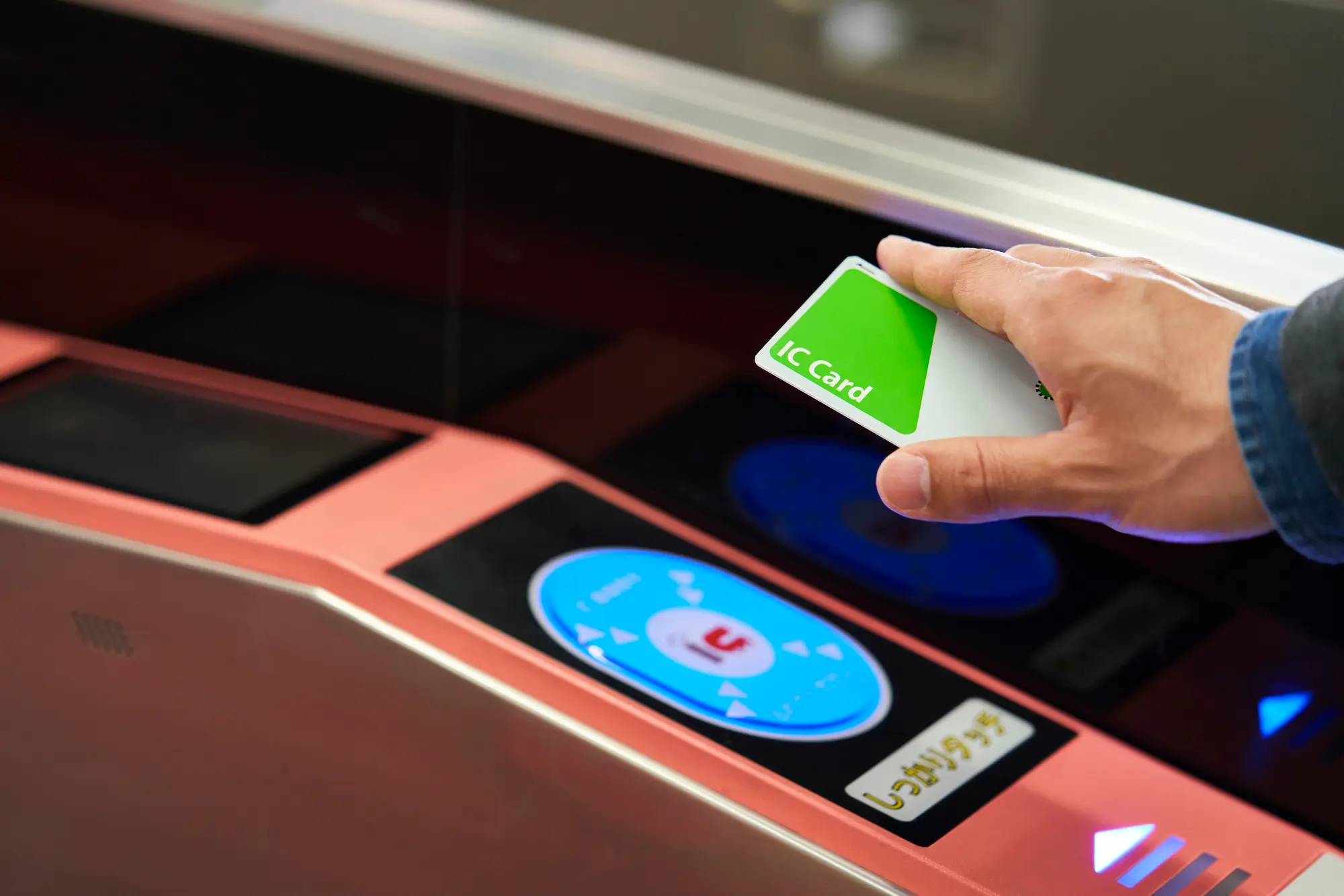
Suica and Welcome Suica
SuicaとWelcome Suica
What is Suica?
Suica is a rechargeable IC card issued by the East Japan Railway Company (JR East) and Tokyo Rinkai Rapid Transit. In addition to trains, buses, and taxis, it can also be used for payments at restaurants, convenience stores, and drugstores. Suica can be easily recharged at train stations and convenience stores, making it a convenient option that eliminates the need to carry or count coins for each payment.
Suica Usage Areas
As of November 2025, Suica can be used in the Tokyo metropolitan area, the Sendai, Niigata, Aomori, Morioka, and Akita areas, as well as parts of the Hokkaido, Tokai, West Japan, and Kyushu areas.
“Note: If you are traveling across different areas (for example, from Tokyo to Sendai, Hokkaido, or Tokai), you must purchase a separate ticket. For long-distance travel, please use Shinkansen or Limited Express tickets.
Differences Between Welcome Suica and Regular Suica
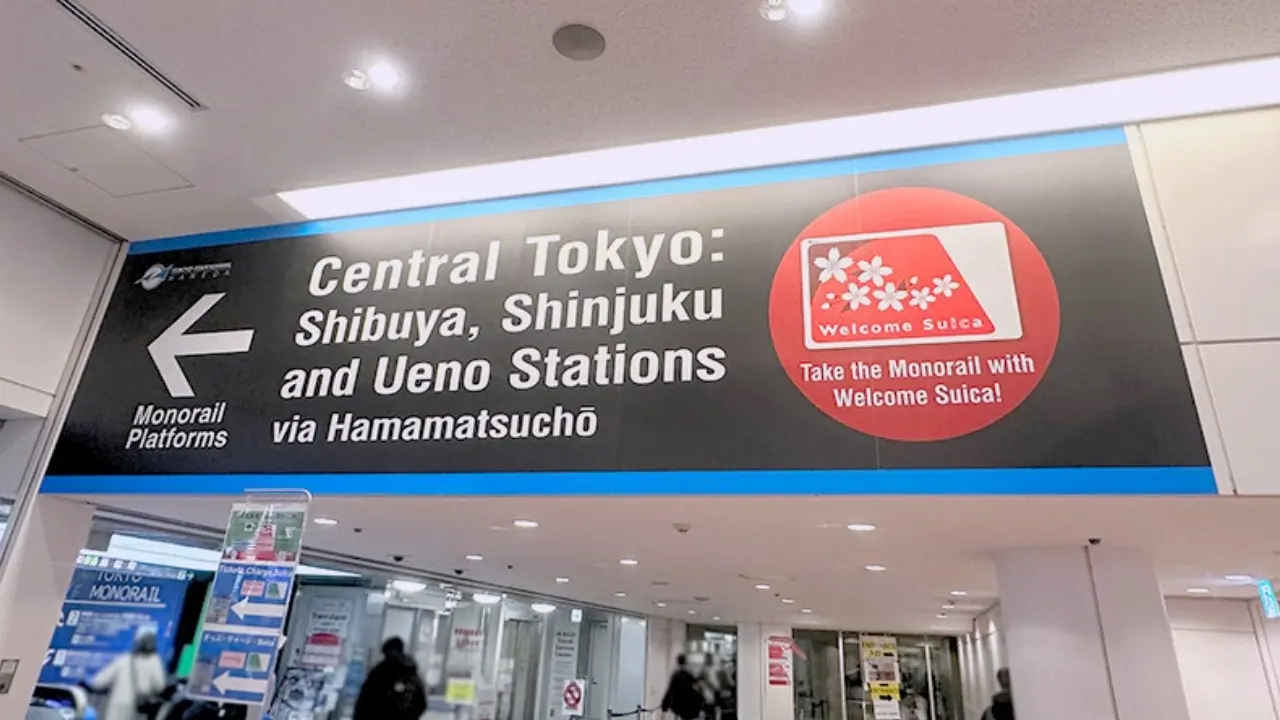
Welcome Suica sign / Photo by Japaniche
For tourists, the Welcome Suica is highly recommended. It is valid for 28 days from the date of purchase. In addition to being usable in many areas across Japan, it can store discounted value tickets such as the Tokyo Free Ticket. Furthermore, it does not require the 500 yen deposit fee usually charged when issuing a regular Suica. There are versions for adults and children (up to age 12), with child fares being half the price.
In addition to the physical card, there is a mobile app version valid for 180 days. With Welcome Suica Mobile, you can use tickets for the Shinkansen and other services, top up via Apple Pay, and access tourist information and route guidance features.
Regular Suica cards serve the same purposes and can be used in the same locations. While they require a 500 yen deposit at the time of issuance, they have a long validity period of 10 years from the date of last use, and the remaining balance can be refunded at a service counter upon request.
Which One is Recommended?
In general, the usage and capabilities are the same, so you can choose based on the amount you plan to spend, the duration of your stay, or the card design. However, please be aware that the mobile version may become unusable if your smartphone battery runs out. If you are unable to pay the fare for your full journey, you will need to report it to station staff and settle the balance, which may take extra time, so please be mindful.
The standard Suica card features a green design with the iconic penguin mascot, while the Welcome Suica is red and decorated with cherry blossom motifs. Limited-edition designs are also released from time to time to coincide with special events or commemorative occasions. Information on release dates and purchasing methods is announced via the official website and social media channels of East Japan Railway Company.
Notably, it has been decided that the Suica Penguin, who has served as the mascot character since 2001, is scheduled to be retired at the end of fiscal year 2026. Originally a character from a picture book by Chiharu Sakazaki, the penguin was first used as an illustration for Suica trial recruitment booklets and promotional posters. Due to its massive popularity, it was officially adopted in 2003. Since then, it has been featured on IC card designs and developed into various merchandise. Following the retirement at the end of 2026, the sale of character goods is also scheduled to end. If you want a card featuring the Suica Penguin design or penguin-related merchandise, it is recommended to purchase them while they are still available.
Differences Between Welcome Suica Mobile and Card Versions
Let’s look at the specific differences between the mobile app and the physical IC card.
Method of Acquisition
- Mobile Version: (As of 2025, only compatible with iOS) Simply download the app and enter the required information to start using it immediately.
- Physical IC Card Version: Available for purchase at dedicated vending machines at Narita Airport and Haneda Airport, at JR EAST Travel Service Centers, and the JAPAN RAIL CAFE in Tokyo Station.
How to Charge
The card-type Suica can only be recharged with cash. Credit card top-ups are not available, so be sure to plan accordingly.
The mobile version allows recharging with both cash and Apple Pay.
Please note that any remaining balance is non-refundable, even if the full amount charged is not used, so it is important to be mindful of how much you add.
User Experience
The IC card version works regardless of your phone's battery life, and there are many ticket machines at stations that support topping up. Another upside is the wide variety of card cases, holders, and IC card stickers available, allowing you to carry your favorite design.
The biggest draw of the mobile version is the convenience. You can handle transportation and store payments with just your smartphone, eliminating the need to take out your wallet. Another advantage is the ability to check your balance instantly within the app.
How to Get Welcome Suica
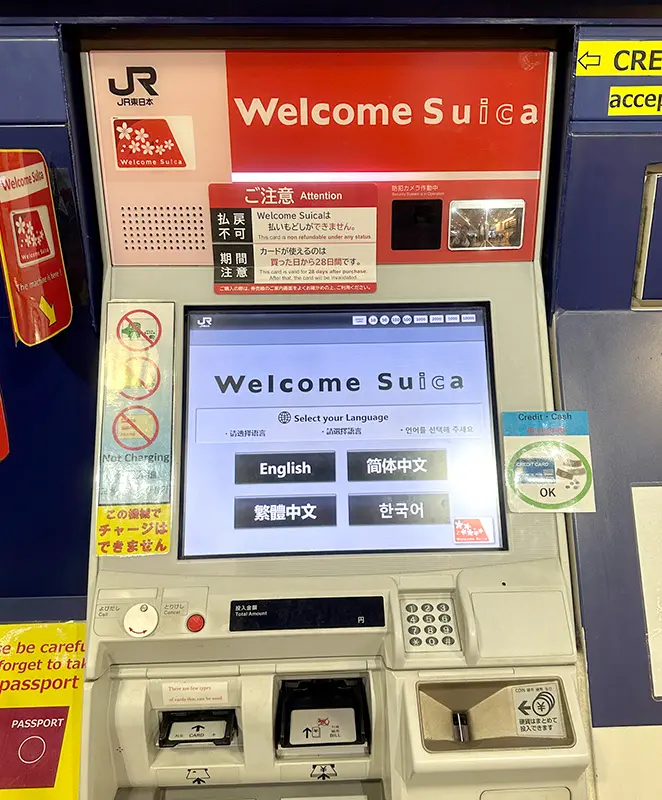
Vending machine for Welcome Suica / Photo by Japaniche
Welcome Suica can be purchased at the following locations. Since sales locations are listed on the official JR East website, please check the site for the latest information.
- Welcome Suica Dedicated Vending Machines
- JR EAST Travel Service Centers
- JAPAN RAIL CAFE
- TAKANAWA GATEWAY Travel Service Center
Welcome Suica Dedicated Vending Machines Locations
- Narita Airport Station
- Airport Terminal 2·3 Station
- Haneda Airport Terminal 3 Station
JR EAST Travel Service Centers
- Narita Airport Station
- Airport Terminal 2·3 Station
- Haneda Airport Terminal 3 Station
- Shinjuku Station (New South Gate, East Gate)
- Tokyo Station
- Ikebukuro Station
- Ueno Station
- Shibuya Station
- Yokohama Station
- Sendai Station
“Note: Sales are temporarily suspended at the following locations (as of November 2025): Kashiwa Station, Kawasaki Station, Tachikawa Station, Omiya Station, Funabashi Station, Fukushima Station, Niigata Station.
JAPAN RAIL CAFE
- Tokyo Station
TAKANAWA GATEWAY Travel Service Center
- Takanawa Gateway Station
How to Charge Welcome Suica
For the physical Welcome Suica card, you select a pre-charged amount at the time of purchase: 1,000 yen, 2,000 yen, 3,000 yen, 4,000 yen, 5,000 yen, or 10,000 yen. Depending on your travel distance, choosing 10,000 yen is the safest option if you also plan to pay for meals and shopping with Suica. However, since the balance is non-refundable, if you are concerned about overcharging, it is better to choose a smaller initial amount and add more as needed at station ticket machines, convenience stores, or Seven Bank ATMs.
The maximum charge limit as of 2025 is 20,000 yen. Incidentally, it is planned to increase the limit to 300,000 yen and introduce a new QR code payment feature by autumn 2026.
Payment Methods with Welcome Suica
Currently, transportation IC cards are used in many places across Japan. They can be used for public transport, convenience stores, dining, shopping, and coin lockers in stations.
Payments with Welcome Suica can be made at any transportation facility or store displaying the "Suica" or "IC" logo, or signs indicating that transportation IC cards are accepted forms of payment.
At a cash register, you can simply tell the cashier your intent to pay with Suica. An easy phrase to use would be “Suica-de”.
For self-checkout/cashless payment, simply select “Transportation IC card” (交通系IC) from the payment options.